# Web3SecurityGuide

80.65K
#Web3SecurityGuide
Web3 Security Guide
Introduction: The Reality of Web3 Security
Web3 represents a decentralized financial and digital ecosystem where users fully control their assets using blockchain technology. This includes cryptocurrencies, NFTs, DeFi platforms, and smart contracts.
However, with this freedom comes responsibility.
Unlike traditional finance, there is:
No central bank to reverse transactions No customer support to recover stolen funds easily
No middle authority controlling risk
This makes security the most important pillar of Web3 participation.
Platforms like Gate.i
  • Reward
  • Comment
  • Repost
  • Share
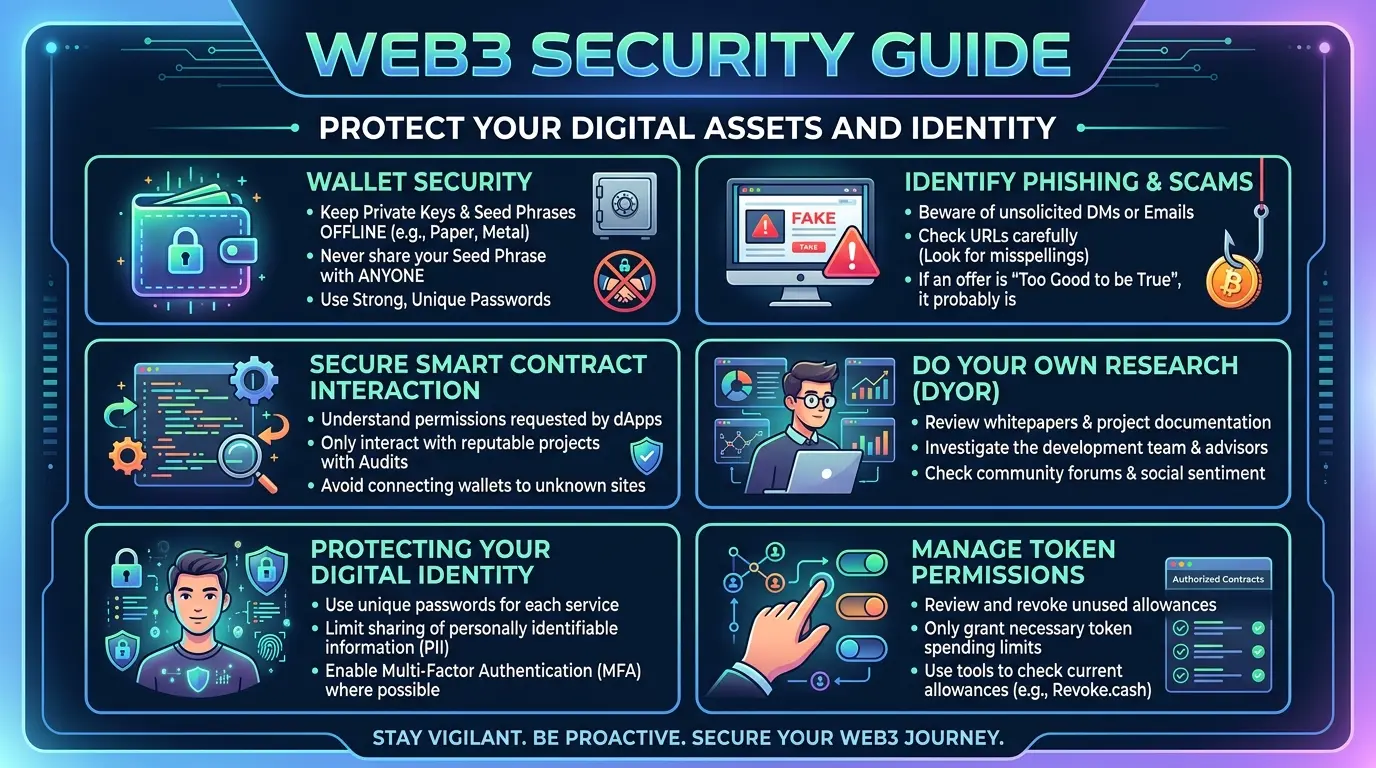
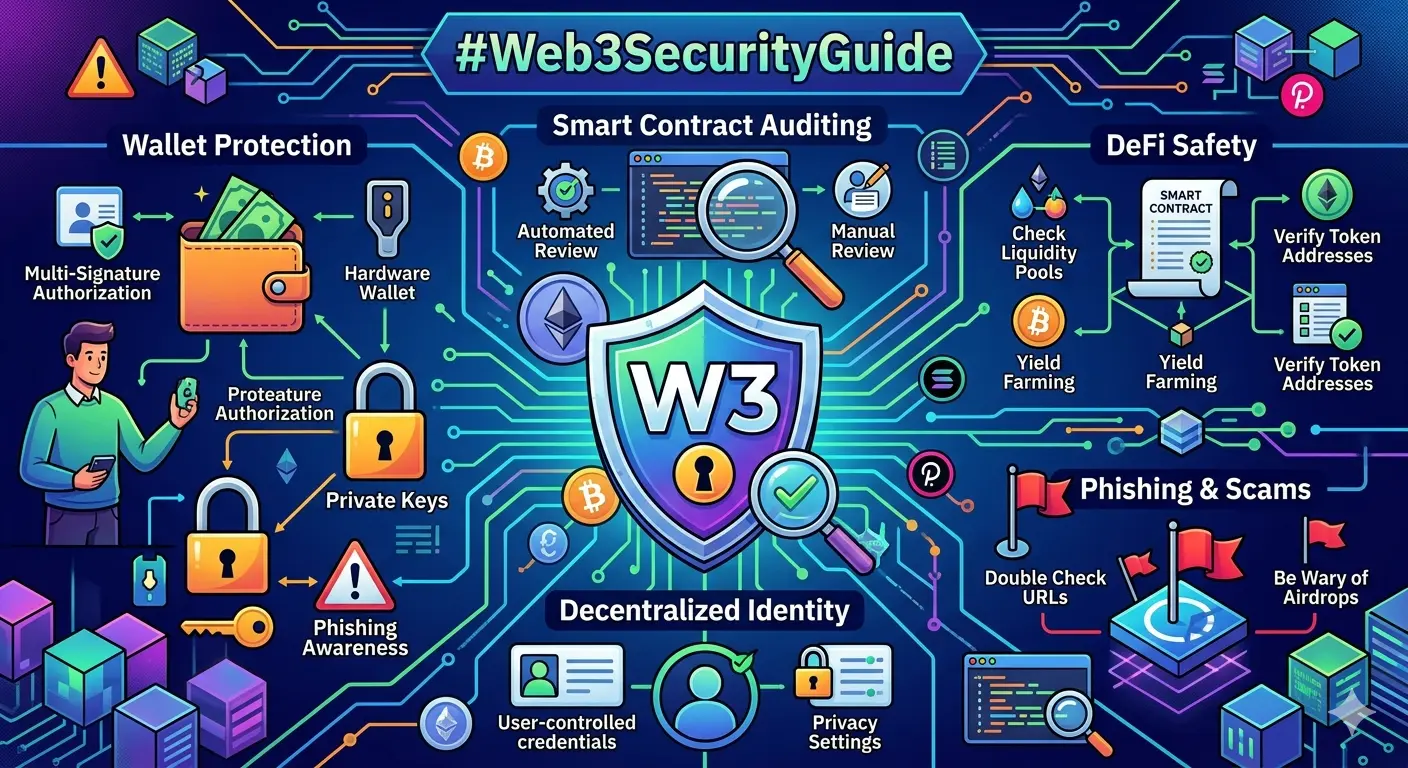
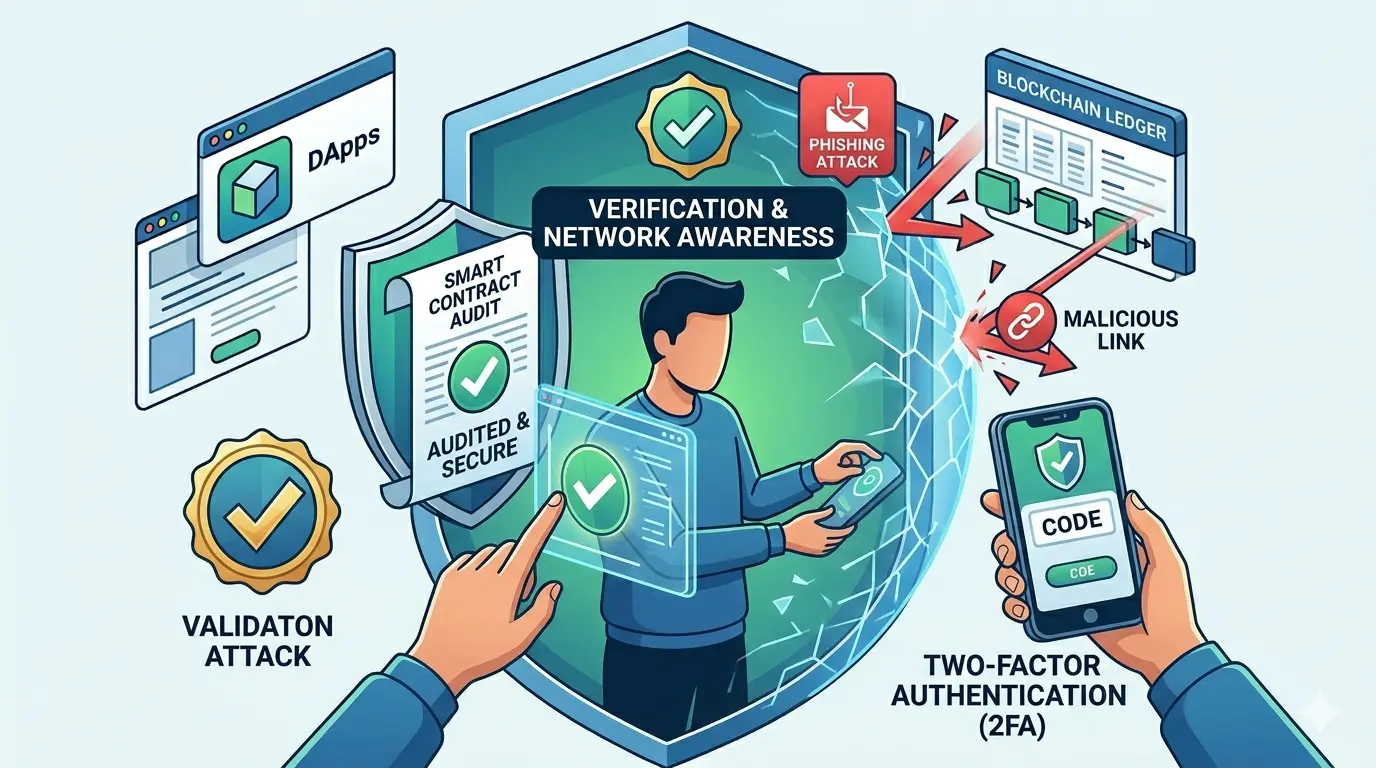
#Web3SecurityGuide Web3 security is one of the most critical foundations of the decentralized digital economy. As blockchain adoption grows across DeFi, NFTs, crypto trading, and decentralized applications, security risks are also increasing. Understanding how to protect digital assets, wallets, and identities is essential for every user, investor, and developer.
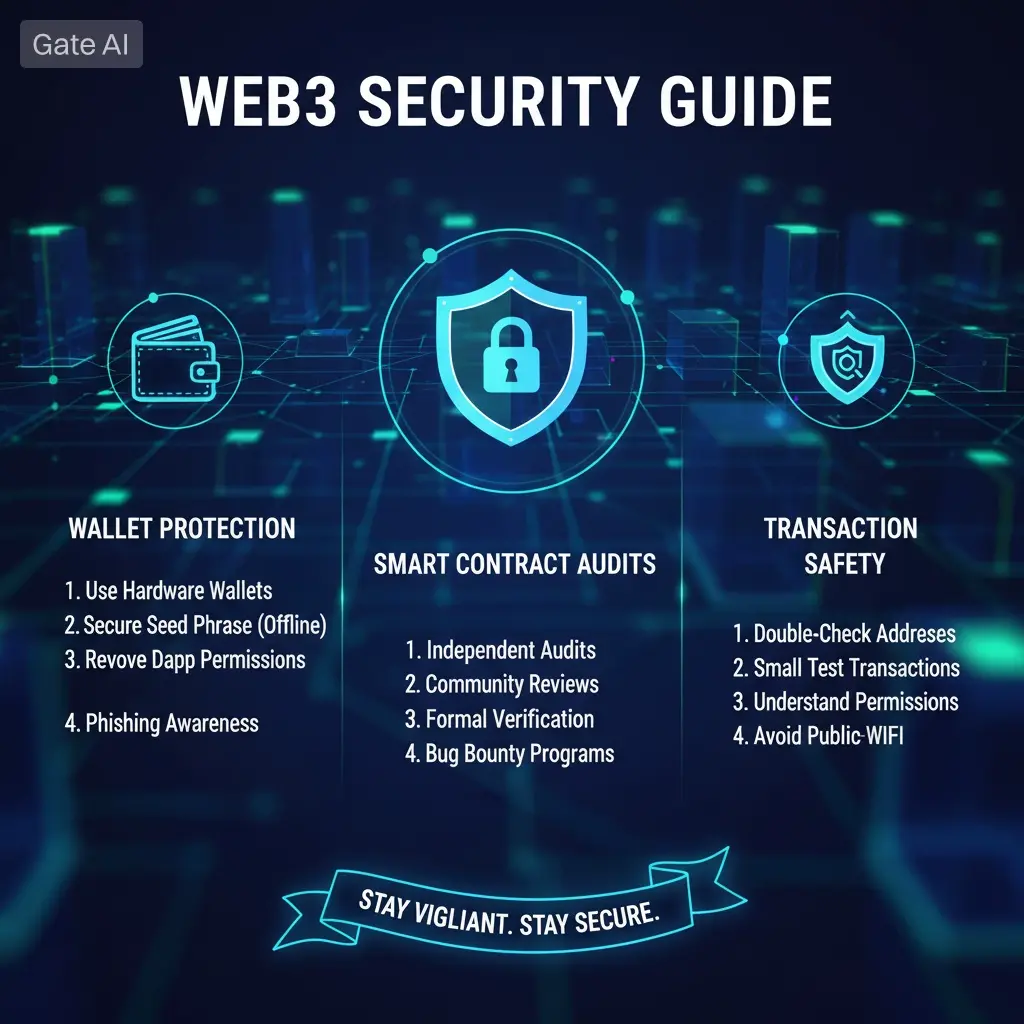
The first and most important layer of security is wallet protection. A Web3 wallet is your gateway to blockchain networks, and losing access means losing control of your assets. Always secure your private keys and seed phrases offline
post-image
  • Reward
  • 1
  • Repost
  • Share
MuzammilYasin:
yeuesu is the best time you want to get the top 10 most likely to you and send it back to you tomorrow and see if I come
#Web3SecurityGuide
MOST PEOPLE DON’T GET FLAGGED FOR PROFITS — THEY GET FLAGGED FOR BEHAVIOR.
In crypto and digital finance, deposits are usually easy.
But withdrawals? That’s where risk systems become aggressive.
What triggers risk alerts?
• Large deposits after long inactivity
• Third-party bank accounts or cards
• Fast deposit → instant withdrawal behavior
• Multiple wallets/accounts with inconsistent activity
• Sudden volume spikes that don’t match your history
• Repeated withdrawals to new addresses
Result?
• Withdrawal delays
• Manual compliance reviews
• KYC/source-of-funds checks
DragonFlyOfficial
#Web3SecurityGuide
🧠 Deposit & Withdrawal Risk Breakdown (Real-World View)
⚠️ 1. Main Risks When Depositing Funds
Deposits are usually “easy entry,” but still monitored.
🚨 Common triggers:
Depositing from unverified or mismatched bank accounts/cards
Using third-party payment sources
Sudden large deposits after long inactivity
Multiple deposits in a short time from different sources
Funds linked to high-risk jurisdictions or flagged services
📉 What happens:
Temporary holds
Extra verification (KYC/Source of Funds)
Risk scoring downgrade
⚠️ 2. Main Risks When Withdrawing Funds
Withdrawals are much more sensitive than deposits.
🚨 Common triggers:
Large withdrawals without prior activity history
Rapid deposit → immediate withdrawal pattern
Frequent withdrawals to new or unrelated accounts
Crypto withdrawals to new wallets repeatedly
Breaking “normal behavior pattern” of the account
📉 What happens:
Withdrawal delays
Manual review
Temporary or permanent restriction
Account freeze in severe cases
🧩 3. How Risk Controls Think (Important Insight)
Risk systems don’t judge “profit” — they detect behavior anomalies:
They compare:
Your current activity vs your history
Your identity consistency
Your geographic/IP consistency
Your transaction patterns vs normal users
If you look “unpredictable” → system flags you.
🛡️ 4. How to Avoid Triggering Risk Controls (Safe Practices)
✔️ Best practices:
Always use your own verified payment methods
Keep consistent deposit/withdraw patterns
Avoid sudden large jumps in volume
Complete full KYC verification early
Use same bank/card/wallet identity over time
Don’t rapidly move funds in and out (“wash-like behavior” risk signal)
❌ Avoid:
Third-party funding
Multiple accounts or identity mixing
Fast in-out cycles
Random wallet hopping without history
🔒 5. If Your Card or Account Gets Frozen
This is where most people panic — but the solution is usually procedural.
🧾 Step-by-step:
1️⃣ Check email/app notifications
Most platforms explain the reason (KYC, risk review, compliance)
2️⃣ Complete verification immediately
ID, proof of funds, source of income if requested
3️⃣ Do NOT create new accounts
This worsens risk score and can escalate restrictions
4️⃣ Contact support with clear documentation
Be consistent and factual — no emotional arguments
5️⃣ Wait for manual review
Risk teams need time; repeated attempts slow the process
💸 6. Safer Withdrawal Strategies (Key for Traders)
🧠 Smart approach:
Withdraw in consistent amounts over time
Avoid withdrawing immediately after deposits
Keep a buffer balance on exchange
Use trusted, previously used addresses/accounts
Separate trading capital vs withdrawal capital
📊 7. Key Reality Most People Miss
Most restrictions are not “punishment” — they are:
Automated risk protection systems
Anti-fraud compliance rules
Behavior anomaly detection
In other words:
If your activity looks like a bot, scam flow, or unstable identity pattern — you get flagged.
⚠️ Risk Warning
Financial platforms (banks, exchanges, payment apps) use strict compliance systems. Incorrect behavior patterns can lead to temporary or permanent restrictions. Always follow platform rules and maintain transparent transaction history.
🧭 Bottom Line (Practical Truth)
If you want smooth withdrawals long-term:
Be predictable
Be verified
Be consistent
Avoid “fast money in / fast money out” behavior
That’s what keeps accounts stable.

repost-content-media
  • Reward
  • Comment
  • Repost
  • Share
#𝐖𝐄𝐁𝟑 𝐒𝐄𝐂𝐔𝐑𝐈𝐓𝐘 𝐆𝐔𝐈𝐃𝐄 — 𝐓𝐇𝐄 𝐑𝐈𝐒𝐊𝐒 𝐍𝐎 𝐎𝐍𝐄 𝐓𝐄𝐋𝐋𝐒 𝐘𝐎𝐔 𝐀𝐁𝐎𝐔𝐓 𝐔𝐍𝐓𝐈𝐋 𝐈𝐓 𝐈𝐒 𝐓𝐎𝐎 𝐋𝐀𝐓𝐄
🔹Depositing funds feels safe. Withdrawing feels routine. Until a card gets frozen, an account gets restricted, or a transaction triggers a risk control flag that was never explained. The blockchain is transparent. The banking layer that connects it to the real world is anything but. Understanding where the risks actually sit is what separates a smooth experience from a frozen one.
▪️The Deposit Side: What Can Go Wrong
🔹The most common deposit risk has nothin
User_any
#𝐖𝐄𝐁𝟑 𝐒𝐄𝐂𝐔𝐑𝐈𝐓𝐘 𝐆𝐔𝐈𝐃𝐄 — 𝐓𝐇𝐄 𝐑𝐈𝐒𝐊𝐒 𝐍𝐎 𝐎𝐍𝐄 𝐓𝐄𝐋𝐋𝐒 𝐘𝐎𝐔 𝐀𝐁𝐎𝐔𝐓 𝐔𝐍𝐓𝐈𝐋 𝐈𝐓 𝐈𝐒 𝐓𝐎𝐎 𝐋𝐀𝐓𝐄
🔹Depositing funds feels safe. Withdrawing feels routine. Until a card gets frozen, an account gets restricted, or a transaction triggers a risk control flag that was never explained. The blockchain is transparent. The banking layer that connects it to the real world is anything but. Understanding where the risks actually sit is what separates a smooth experience from a frozen one.
▪️The Deposit Side: What Can Go Wrong
🔹The most common deposit risk has nothing to do with the blockchain. It sits in the gap between the exchange and the bank. When funds move from a bank account to a platform, the transaction passes through multiple intermediaries. Each one runs its own risk scoring. A transfer that looks routine to the sender can look suspicious to an algorithm three layers down the chain.
🔹The practical steps are straightforward. Use bank accounts registered in the same name as the exchange account, always. Mismatched names trigger automated flags instantly. Keep transfer amounts consistent with the account's historical activity pattern. A sudden large deposit into an account that normally sees small transactions is the single most common trigger for a manual review. Save every transaction confirmation and screenshot the deposit flow before confirming. If something goes wrong, the support team needs the transaction hash, the exact amount, and the timestamp. Having those ready before a problem starts saves hours.
▪️The Withdrawal Side: Where Most Problems Start
🔹Withdrawals carry higher risk than deposits for one simple reason. Banks are more suspicious of money leaving an exchange than money entering one. The logic is built into the compliance framework. Funds arriving from a regulated platform have a known source. Funds leaving to a personal wallet or an external account have no guaranteed destination in the bank's view.
🔹The safest withdrawal path is always to a wallet the user fully controls, not directly to a bank account. Moving directly from exchange to bank creates a paper trail that links crypto activity to a personal financial profile. Some banks flag this connection and restrict the account without warning. The smarter route is exchange to self-custody wallet first, then wallet to bank separately. This creates a clean separation between crypto activity and banking activity that most compliance systems interpret as lower risk.
▪️The Card Freeze and Account Restriction Problem
🔹This is the scenario no one prepares for. A card gets frozen mid-transaction. An account shows a restriction notice with no explanation. The first instinct is to contact support immediately, but the second step matters more. Document everything before reaching out. Screenshot the frozen account page. Note the exact time the restriction appeared. List every recent transaction the account was involved in. This information is what the compliance team will ask for, and having it ready shortens the resolution timeline significantly.
🔹Most freezes are temporary and automated. They trigger when a transaction pattern deviates from the account's normal behavior. Large withdrawals to new addresses. Multiple transactions in rapid succession. Activity from a new device or IP address. These are not signs of a problem with the user. They are signs the system is doing its job. But understanding why they happen changes how to respond to them.
▪️The Risk Control Layer: How It Works and How to Work With It
🔹Risk control systems operate on pattern recognition. They do not understand intent. They understand deviation from baseline. An account that deposits funds, waits for them to clear, makes a single trade, and attempts to withdraw immediately is a textbook pattern for money laundering flags, even when the user is doing nothing wrong.
🔹The approach that avoids most flags is simple. Maintain consistent activity. Avoid rapid deposit-then-immediately-withdraw patterns. Use the same devices and networks the account has always used. When traveling or switching devices, update security settings before initiating transactions. These are friction points, but they exist because the system is trying to distinguish legitimate activity from account takeovers.
▪️The Practical Framework for Safer Movement of Funds
🔹Every transaction sits somewhere on a risk spectrum. The goal is to move it toward the safer end through behavior, not through hoping the system will understand.
🔹Use accounts registered in the same legal name for all fiat on-ramp and off-ramp activity. Keep transaction sizes consistent with account history. Avoid using exchange accounts for payments to third parties; exchange accounts are not payment processors and using them as such is a fast path to restrictions. Maintain separate wallets for trading, holding, and spending. This compartmentalization limits exposure if any single wallet or account faces an issue.
🔹When a freeze or restriction does occur, the response sequence matters. Document first. Contact support with the documentation ready. Provide exactly the information requested, nothing less and nothing more. Over-explaining to a compliance algorithm does not help. Clear, concise, factual responses do.
▪️The Reality Behind the Guide
🔹The blockchain layer is permissionless. The banking layer is not. The gap between them is where every freeze, restriction, and compliance hold lives. Navigating that gap is a skill, not a given. Deposits are generally safer than withdrawals. Withdrawals to self-custody wallets are safer than direct withdrawals to bank accounts. Consistent, predictable behavior is safer than erratic, large, or novel transaction patterns.
🔹No guide can prevent every risk. But knowing where the risks actually sit, in the banking layer, in the pattern recognition systems, in the compliance frameworks that connect fiat and crypto, makes them manageable. The goal is not to avoid the system. The goal is to move through it without triggering its alarms. That is possible. It just requires understanding how the alarms work.
#GateSquare #CreatorCarnival
#Web3SecurityGuide
#GateSquareMayTradingShare
repost-content-media
  • Reward
  • 9
  • Repost
  • Share
GateUser-8c33de42:
To The Moon 🌕
View More
#𝐖𝐄𝐁𝟑 𝐒𝐄𝐂𝐔𝐑𝐈𝐓𝐘 𝐆𝐔𝐈𝐃𝐄 — 𝐓𝐇𝐄 𝐑𝐈𝐒𝐊𝐒 𝐍𝐎 𝐎𝐍𝐄 𝐓𝐄𝐋𝐋𝐒 𝐘𝐎𝐔 𝐀𝐁𝐎𝐔𝐓 𝐔𝐍𝐓𝐈𝐋 𝐈𝐓 𝐈𝐒 𝐓𝐎𝐎 𝐋𝐀𝐓𝐄
🔹Depositing funds feels safe. Withdrawing feels routine. Until a card gets frozen, an account gets restricted, or a transaction triggers a risk control flag that was never explained. The blockchain is transparent. The banking layer that connects it to the real world is anything but. Understanding where the risks actually sit is what separates a smooth experience from a frozen one.
▪️The Deposit Side: What Can Go Wrong
🔹The most common deposit risk has nothin
User_any
#𝐖𝐄𝐁𝟑 𝐒𝐄𝐂𝐔𝐑𝐈𝐓𝐘 𝐆𝐔𝐈𝐃𝐄 — 𝐓𝐇𝐄 𝐑𝐈𝐒𝐊𝐒 𝐍𝐎 𝐎𝐍𝐄 𝐓𝐄𝐋𝐋𝐒 𝐘𝐎𝐔 𝐀𝐁𝐎𝐔𝐓 𝐔𝐍𝐓𝐈𝐋 𝐈𝐓 𝐈𝐒 𝐓𝐎𝐎 𝐋𝐀𝐓𝐄
🔹Depositing funds feels safe. Withdrawing feels routine. Until a card gets frozen, an account gets restricted, or a transaction triggers a risk control flag that was never explained. The blockchain is transparent. The banking layer that connects it to the real world is anything but. Understanding where the risks actually sit is what separates a smooth experience from a frozen one.
▪️The Deposit Side: What Can Go Wrong
🔹The most common deposit risk has nothing to do with the blockchain. It sits in the gap between the exchange and the bank. When funds move from a bank account to a platform, the transaction passes through multiple intermediaries. Each one runs its own risk scoring. A transfer that looks routine to the sender can look suspicious to an algorithm three layers down the chain.
🔹The practical steps are straightforward. Use bank accounts registered in the same name as the exchange account, always. Mismatched names trigger automated flags instantly. Keep transfer amounts consistent with the account's historical activity pattern. A sudden large deposit into an account that normally sees small transactions is the single most common trigger for a manual review. Save every transaction confirmation and screenshot the deposit flow before confirming. If something goes wrong, the support team needs the transaction hash, the exact amount, and the timestamp. Having those ready before a problem starts saves hours.
▪️The Withdrawal Side: Where Most Problems Start
🔹Withdrawals carry higher risk than deposits for one simple reason. Banks are more suspicious of money leaving an exchange than money entering one. The logic is built into the compliance framework. Funds arriving from a regulated platform have a known source. Funds leaving to a personal wallet or an external account have no guaranteed destination in the bank's view.
🔹The safest withdrawal path is always to a wallet the user fully controls, not directly to a bank account. Moving directly from exchange to bank creates a paper trail that links crypto activity to a personal financial profile. Some banks flag this connection and restrict the account without warning. The smarter route is exchange to self-custody wallet first, then wallet to bank separately. This creates a clean separation between crypto activity and banking activity that most compliance systems interpret as lower risk.
▪️The Card Freeze and Account Restriction Problem
🔹This is the scenario no one prepares for. A card gets frozen mid-transaction. An account shows a restriction notice with no explanation. The first instinct is to contact support immediately, but the second step matters more. Document everything before reaching out. Screenshot the frozen account page. Note the exact time the restriction appeared. List every recent transaction the account was involved in. This information is what the compliance team will ask for, and having it ready shortens the resolution timeline significantly.
🔹Most freezes are temporary and automated. They trigger when a transaction pattern deviates from the account's normal behavior. Large withdrawals to new addresses. Multiple transactions in rapid succession. Activity from a new device or IP address. These are not signs of a problem with the user. They are signs the system is doing its job. But understanding why they happen changes how to respond to them.
▪️The Risk Control Layer: How It Works and How to Work With It
🔹Risk control systems operate on pattern recognition. They do not understand intent. They understand deviation from baseline. An account that deposits funds, waits for them to clear, makes a single trade, and attempts to withdraw immediately is a textbook pattern for money laundering flags, even when the user is doing nothing wrong.
🔹The approach that avoids most flags is simple. Maintain consistent activity. Avoid rapid deposit-then-immediately-withdraw patterns. Use the same devices and networks the account has always used. When traveling or switching devices, update security settings before initiating transactions. These are friction points, but they exist because the system is trying to distinguish legitimate activity from account takeovers.
▪️The Practical Framework for Safer Movement of Funds
🔹Every transaction sits somewhere on a risk spectrum. The goal is to move it toward the safer end through behavior, not through hoping the system will understand.
🔹Use accounts registered in the same legal name for all fiat on-ramp and off-ramp activity. Keep transaction sizes consistent with account history. Avoid using exchange accounts for payments to third parties; exchange accounts are not payment processors and using them as such is a fast path to restrictions. Maintain separate wallets for trading, holding, and spending. This compartmentalization limits exposure if any single wallet or account faces an issue.
🔹When a freeze or restriction does occur, the response sequence matters. Document first. Contact support with the documentation ready. Provide exactly the information requested, nothing less and nothing more. Over-explaining to a compliance algorithm does not help. Clear, concise, factual responses do.
▪️The Reality Behind the Guide
🔹The blockchain layer is permissionless. The banking layer is not. The gap between them is where every freeze, restriction, and compliance hold lives. Navigating that gap is a skill, not a given. Deposits are generally safer than withdrawals. Withdrawals to self-custody wallets are safer than direct withdrawals to bank accounts. Consistent, predictable behavior is safer than erratic, large, or novel transaction patterns.
🔹No guide can prevent every risk. But knowing where the risks actually sit, in the banking layer, in the pattern recognition systems, in the compliance frameworks that connect fiat and crypto, makes them manageable. The goal is not to avoid the system. The goal is to move through it without triggering its alarms. That is possible. It just requires understanding how the alarms work.
#GateSquare #CreatorCarnival
#Web3SecurityGuide
#GateSquareMayTradingShare
repost-content-media
  • Reward
  • Comment
  • Repost
  • Share
#Web3SecurityGuide
As Web3 adoption continues to grow, security has become one of the most critical topics for users, investors, and developers. Unlike traditional finance, Web3 gives users full control of their assets through blockchain-based systems such as Ethereum, but with this freedom comes full responsibility.
In Web3, there is no central authority to recover lost funds or reverse transactions. This makes security awareness essential for anyone interacting with decentralized applications (dApps), DeFi platforms, NFTs, or crypto wallets.
1. Secure Your Wallet First
Your crypto wallet is
ETH-0.32%
post-image
post-image
  • Reward
  • 4
  • Repost
  • Share
ybaser:
To The Moon 🌕
View More
#Web3SecurityGuide
Web3 Security Guide
Introduction: The Reality of Web3 Security
Web3 represents a decentralized financial and digital ecosystem where users fully control their assets using blockchain technology. This includes cryptocurrencies, NFTs, DeFi platforms, and smart contracts.
However, with this freedom comes responsibility.
Unlike traditional finance, there is:
No central bank to reverse transactions No customer support to recover stolen funds easily
No middle authority controlling risk
This makes security the most important pillar of Web3 participation.
Platforms like Gate.i
post-image
  • Reward
  • Comment
  • Repost
  • Share
#Web3SecurityGuide — SURVIVAL MANUAL FOR A DECENTRALIZED BUT DANGEROUS ECOSYSTEM
Web3 is often sold as freedom, ownership, and decentralization, but the uncomfortable truth is that it is also one of the most unforgiving financial environments ever created. There is no customer support to reverse your mistake, no central authority to refund your loss, and no safety net when you click the wrong link or sign the wrong transaction. In traditional finance, mistakes can sometimes be corrected. In Web3, mistakes are often final. That is why security is not an optional skill here—it is the foundation
post-image
  • Reward
  • 4
  • Repost
  • Share
MrFlower_XingChen:
To The Moon 🌕
View More
#Web3SecurityGuide
🚨 WEB3 SECURITY GUIDE: IN CRYPTO, PROTECTING YOUR ASSETS IS JUST AS IMPORTANT AS GROWING THEM 🚨
One of the biggest mistakes people make when entering crypto is believing the only challenge is finding profitable opportunities. They spend hours searching for the next breakout coin, the next trending narrative, or the next high-potential trade — while ignoring one critical reality:
In Web3, you are your own bank.
And with that freedom comes full responsibility.
Because unlike traditional finance, crypto transactions are usually irreversible. If funds are stolen, sent to the
post-image
post-image
  • Reward
  • 1
  • Repost
  • Share
MarketGoddess:
Great Information
#Web3SecurityGuide Web3 represents the next evolution of the internet, where users gain control over their data, identity, and digital assets through blockchain technology. Unlike traditional Web2 platforms where centralized companies control everything, Web3 introduces decentralization, transparency, and user ownership. However, with these advantages also come new security risks that users must understand to stay safe.
This guide explains essential Web3 security practices, common threats, and how individuals can protect themselves in the decentralized ecosystem.
Understanding Web3 Security
We
post-image
  • Reward
  • 3
  • Repost
  • Share
iceTrader:
LFG 🔥
View More
Load More