










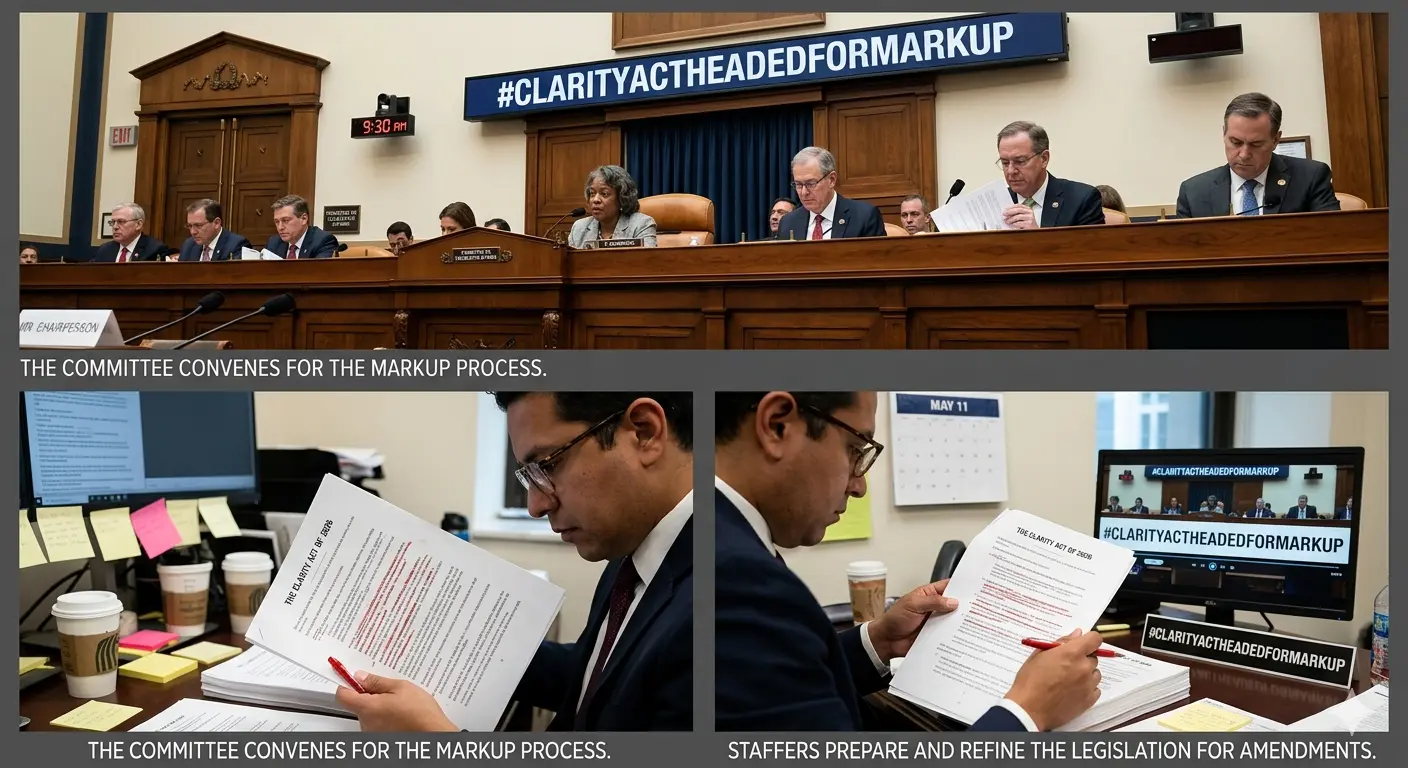

#CLARITYActHeadedForMarkup
The cryptocurrency industry is entering another major regulatory turning point as the “CLARITY Act” moves toward the markup stage in the legislative process. For digital asset markets, this development is being closely watched because it represents another step toward establishing clearer rules for how cryptocurrencies, blockchain networks, exchanges, stablecoins, and decentralized ecosystems may be regulated in the future.
For years, one of the biggest challenges facing the crypto market has not been technology, liquidity, or adoption — it has been regulatory uncertainty. Investors, institutions, startups, and developers have repeatedly faced confusion over which assets qualify as securities, which agencies hold oversight authority, and how compliance frameworks should operate across rapidly evolving blockchain ecosystems.
The movement of the CLARITY Act toward markup signals that lawmakers are actively refining and debating the details of digital asset regulation instead of leaving the sector in a prolonged gray zone. In financial markets, even the process of regulatory discussion can significantly affect investor psychology because markets prefer predictable frameworks over uncertainty.
---
📊 Why The Market Is Paying Attention
The markup phase is important because it is the stage where lawmakers review, amend, negotiate, and finalize sections of a proposed bill before advancing it further in the legislative process. This means the discussion is shifting from broad concepts into practical implementation details.
Crypto traders and institutions are monitoring this closely because the legislation could influence:
Classification of digital assets
Regulatory jurisdiction boundaries
Exchange compliance standards
Stablecoin oversight
Investor protection rules
Institutional participation pathways
Blockchain innovation incentives
When regulations become clearer, institutional capital often becomes more comfortable entering the market because operational risk decreases.
---
⚡ The Core Issue: Regulatory Uncertainty
One of crypto’s longest-running structural problems has been inconsistent interpretation of digital assets.
Some tokens have been viewed as:
Commodities
Securities
Utility assets
Governance instruments
Payment networks
Without consistent classification frameworks, companies have struggled to operate confidently, and investors have faced uncertainty regarding future enforcement actions.
The CLARITY Act discussion is important because markets hope it may provide more standardized definitions and clearer oversight responsibilities.
---
🏛 Institutional Impact Could Be Significant
Large financial firms typically avoid environments where regulatory ambiguity is high. Even when institutions believe blockchain technology has long-term potential, uncertainty around compliance creates hesitation.
Clearer frameworks could potentially encourage:
More institutional trading participation
Expansion of crypto investment products
Broader banking integration
Increased custody services
Stablecoin infrastructure growth
Markets often react positively when regulation appears to move toward structure instead of restriction.
---
📈 Why Some Traders View This As Bullish
Many crypto investors increasingly believe that regulation is no longer a threat to the industry’s survival but rather a requirement for its maturation.
A structured legal environment may:
Increase investor confidence
Reduce enforcement fears
Encourage long-term capital inflows
Improve market transparency
Support broader adoption
Historically, major financial sectors tend to attract deeper institutional participation once legal frameworks become more established.
---
🔄 Volatility Will Still Remain
Even positive regulatory developments can create volatility because markets constantly reinterpret legislative headlines.
Different scenarios can emerge:
Some provisions may favor innovation
Others may increase compliance burdens
Certain sectors could benefit more than others
Smaller projects may face operational challenges
As amendments evolve during markup discussions, traders may react quickly to changing narratives.
---
🧠 The Bigger Picture For Crypto
The broader significance of the CLARITY Act discussion is that cryptocurrency is increasingly being treated as a permanent part of the financial landscape rather than a temporary speculative trend.
Years ago, many debates focused on whether crypto would survive at all.
Today, the conversation has evolved toward:
How digital assets should be integrated
Which agencies should oversee them
How investor protections should function
How innovation and regulation can coexist
That shift alone represents a major evolution in the industry.
---
🚀 Long-Term Perspective
Markets usually fear uncertainty more than regulation itself.
If the CLARITY Act ultimately contributes to:
clearer compliance pathways,
transparent definitions,
balanced oversight,
and institutional accessibility,
then many investors believe it could strengthen the long-term foundation of the crypto ecosystem.
While short-term volatility around headlines will continue, the movement toward structured regulation may gradually help transform crypto markets from a highly speculative frontier into a more mature global financial sector.
The next stages of the legislative process will likely remain a major focus for traders, institutions, blockchain companies, and policymakers throughout the coming months.
The cryptocurrency industry is entering another major regulatory turning point as the “CLARITY Act” moves toward the markup stage in the legislative process. For digital asset markets, this development is being closely watched because it represents another step toward establishing clearer rules for how cryptocurrencies, blockchain networks, exchanges, stablecoins, and decentralized ecosystems may be regulated in the future.
For years, one of the biggest challenges facing the crypto market has not been technology, liquidity, or adoption — it has been regulatory uncertainty. Investors, institutions, startups, and developers have repeatedly faced confusion over which assets qualify as securities, which agencies hold oversight authority, and how compliance frameworks should operate across rapidly evolving blockchain ecosystems.
The movement of the CLARITY Act toward markup signals that lawmakers are actively refining and debating the details of digital asset regulation instead of leaving the sector in a prolonged gray zone. In financial markets, even the process of regulatory discussion can significantly affect investor psychology because markets prefer predictable frameworks over uncertainty.
---
📊 Why The Market Is Paying Attention
The markup phase is important because it is the stage where lawmakers review, amend, negotiate, and finalize sections of a proposed bill before advancing it further in the legislative process. This means the discussion is shifting from broad concepts into practical implementation details.
Crypto traders and institutions are monitoring this closely because the legislation could influence:
Classification of digital assets
Regulatory jurisdiction boundaries
Exchange compliance standards
Stablecoin oversight
Investor protection rules
Institutional participation pathways
Blockchain innovation incentives
When regulations become clearer, institutional capital often becomes more comfortable entering the market because operational risk decreases.
---
⚡ The Core Issue: Regulatory Uncertainty
One of crypto’s longest-running structural problems has been inconsistent interpretation of digital assets.
Some tokens have been viewed as:
Commodities
Securities
Utility assets
Governance instruments
Payment networks
Without consistent classification frameworks, companies have struggled to operate confidently, and investors have faced uncertainty regarding future enforcement actions.
The CLARITY Act discussion is important because markets hope it may provide more standardized definitions and clearer oversight responsibilities.
---
🏛 Institutional Impact Could Be Significant
Large financial firms typically avoid environments where regulatory ambiguity is high. Even when institutions believe blockchain technology has long-term potential, uncertainty around compliance creates hesitation.
Clearer frameworks could potentially encourage:
More institutional trading participation
Expansion of crypto investment products
Broader banking integration
Increased custody services
Stablecoin infrastructure growth
Markets often react positively when regulation appears to move toward structure instead of restriction.
---
📈 Why Some Traders View This As Bullish
Many crypto investors increasingly believe that regulation is no longer a threat to the industry’s survival but rather a requirement for its maturation.
A structured legal environment may:
Increase investor confidence
Reduce enforcement fears
Encourage long-term capital inflows
Improve market transparency
Support broader adoption
Historically, major financial sectors tend to attract deeper institutional participation once legal frameworks become more established.
---
🔄 Volatility Will Still Remain
Even positive regulatory developments can create volatility because markets constantly reinterpret legislative headlines.
Different scenarios can emerge:
Some provisions may favor innovation
Others may increase compliance burdens
Certain sectors could benefit more than others
Smaller projects may face operational challenges
As amendments evolve during markup discussions, traders may react quickly to changing narratives.
---
🧠 The Bigger Picture For Crypto
The broader significance of the CLARITY Act discussion is that cryptocurrency is increasingly being treated as a permanent part of the financial landscape rather than a temporary speculative trend.
Years ago, many debates focused on whether crypto would survive at all.
Today, the conversation has evolved toward:
How digital assets should be integrated
Which agencies should oversee them
How investor protections should function
How innovation and regulation can coexist
That shift alone represents a major evolution in the industry.
---
🚀 Long-Term Perspective
Markets usually fear uncertainty more than regulation itself.
If the CLARITY Act ultimately contributes to:
clearer compliance pathways,
transparent definitions,
balanced oversight,
and institutional accessibility,
then many investors believe it could strengthen the long-term foundation of the crypto ecosystem.
While short-term volatility around headlines will continue, the movement toward structured regulation may gradually help transform crypto markets from a highly speculative frontier into a more mature global financial sector.
The next stages of the legislative process will likely remain a major focus for traders, institutions, blockchain companies, and policymakers throughout the coming months.
