





Peacefulheart

vip
Age 0.8 Year
Peak Tier 5
No content yet
#MayTokenUnlockWave
#Gate广场五月交易分享
The crypto market in May 2026 is entering one of the most critical liquidity events of the year, as a massive wave of token unlocks collides with evolving macro sentiment, institutional positioning, and major protocol upgrades. This is not just a routine supply event — it is a structural stress test for mid-cap and low-cap crypto assets.
According to the latest aggregated on-chain and vesting data, approximately $41.8 billion worth of tokens are scheduled to be unlocked throughout May, spanning over 140 projects. This translates to an average of $1.3 billion
HYPE-3.38%
ENA-0.37%
SXT0.14%
LINEA-2.37%
post-image
  • Reward
  • 5
  • Repost
  • Share
discovery:
To The Moon 🌕
View More
#JapanTokenizesGovernmentBonds
— The Next Phase Of On-Chain Sovereign Finance 🇯🇵
Japan is no longer just experimenting with blockchain in finance — it is now entering the execution phase of integrating sovereign debt into digital infrastructure. What began as a controlled institutional pilot is evolving into a scalable model that could redefine how global capital moves, settles, and operates across borders.
The initiative led by Progmat, with participation from institutions like Mitsubishi UFJ Financial Group, Mizuho Financial Group, Sumitomo Mitsui Financial Group, and asset managers such
AVAX0.95%
LINK-0.31%
ONDO2.72%
post-image
  • Reward
  • 2
  • Repost
  • Share
discovery:
To The Moon 🌕
View More
#TrumpVisitsChinaMay13
Here’s a fresh, updated Crypto Morning Report (latest 2026 context) with deeper narrative, new data, and stronger market insight 👇
🚀 Crypto Morning Report | May 2026 (Latest Update)
🌍 Macro + Market Overview
The crypto market is currently transitioning into a high-catalyst but cautious phase, where macro events, regulation, and institutional flows are driving price action more than pure speculation.
Bitcoin is stabilizing in a wide macro range after reclaiming key levels, while Ethereum and altcoins are positioning around upcoming upgrades and liquidity rotations. Th
BTC0.38%
ETH0.02%
  • Reward
  • 2
  • Repost
  • Share
discovery:
To The Moon 🌕
View More
#CryptoMinersPivotToAIDC
🚀 Crypto Miners Double Down on AI Infrastructure as the Compute Economy Enters a New Phase (Mid-2026 Outlook)
The structural shift from Bitcoin mining toward AI data center infrastructure is no longer just a trend—it is accelerating into a full-scale industry transformation. What began as selective diversification is now evolving into a competitive race among mining companies to secure long-term positioning within the global AI compute supply chain. The latest developments in 2026 indicate that this transition is deepening, with stronger capi
post-image
  • Reward
  • 4
  • Repost
  • Share
discovery:
To The Moon 🌕
View More
#WCTCTradingKingPK
#WCTCTradingKingPK
🏆 WCTC S8 Enters Final High-Volatility Phase
The World Crypto Trading Competition (WCTC S8) has now moved into its most निर्णायक (decisive) phase, where competition intensity, market volatility, and trader pressure are all rising together. The Champions Showdown (1v1 PK) is now fully active, and the pace of matchups has increased significantly as top traders battle head-to-head in real-time performance-based contests. This stage is no longer about participation — it is about survival, precision, and maximizing ROI under pressure.
As of the latest update,
BTC0.38%
post-image
  • Reward
  • 4
  • Repost
  • Share
discovery:
To The Moon 🌕
View More
#DailyPolymarketHotspot
The global financial system is accelerating into a phase where information is priced instantly, and prediction markets are becoming one of the fastest engines behind that shift. Platforms like Polymarket are no longer experimental — they are evolving into real-time macro intelligence hubs where capital flows reflect expectations before traditional markets fully adjust.
What makes prediction markets unique in 2026 is their capital-backed truth mechanism. Unlike surveys, analyst reports, or social sentiment, these markets force participants to commit money to their views
BTC0.38%
post-image
  • Reward
  • 3
  • Repost
  • Share
discovery:
To The Moon 🌕
View More
#DailyPolymarketHotspot
  • Reward
  • Comment
  • Repost
  • Share
#CLARITYActHeadedForMarkup #CLARITYActHeadedForMarkup The global digital asset landscape is entering a decisive phase where regulation is no longer a distant concept but an active force shaping market structure, capital flows, and innovation pathways. While the delay of the CLARITY Act continues to influence sentiment, new developments across multiple jurisdictions suggest that the future of crypto regulation is evolving into a more coordinated and globally competitive framework rather than a fragmented one.
In the United States, the ongoing uncertainty surrounding the CLARITY Act is being par
post-image
  • Reward
  • 3
  • Repost
  • Share
discovery:
To The Moon 🌕
View More
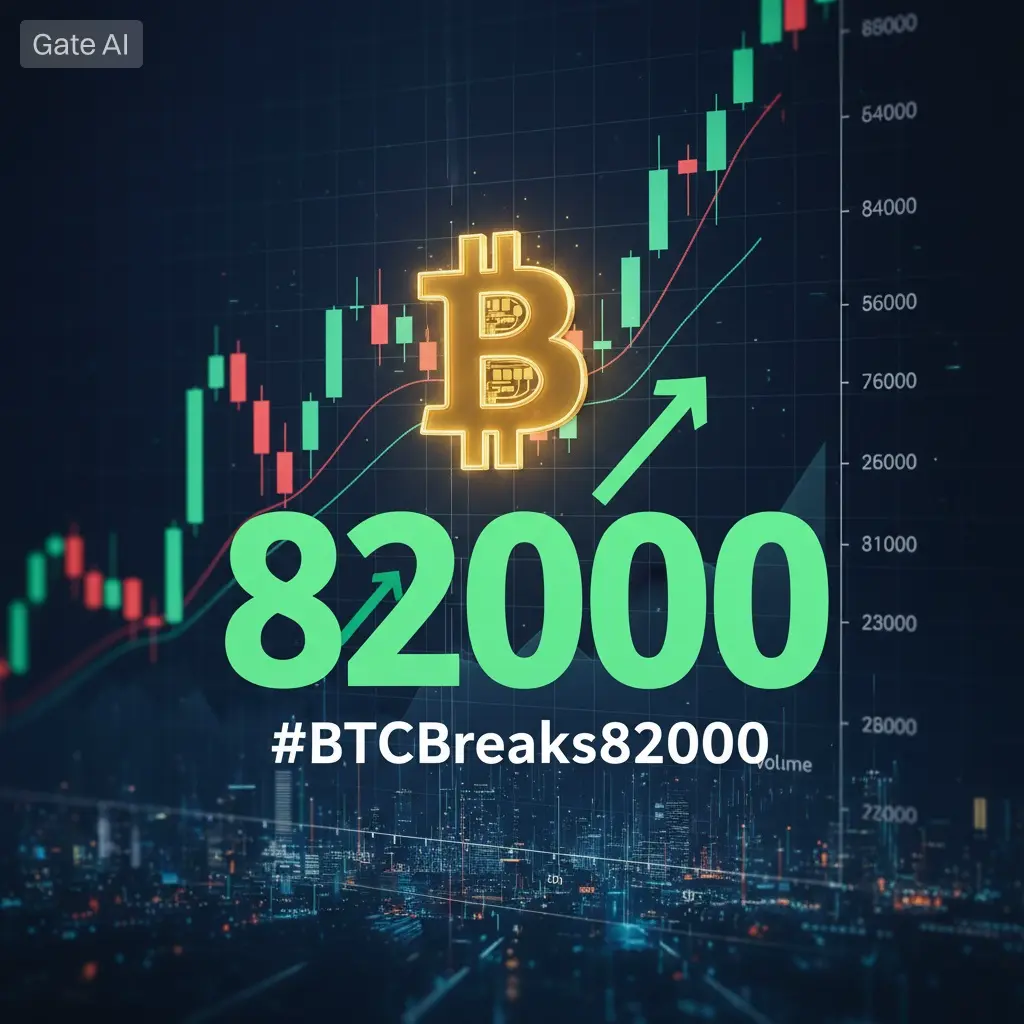
#BTCBreaks82000
Bitcoin Holds Above $80K — What’s Next for the Market?
Bitcoin continues to trade firmly above the $80,000 level in mid-May 2026, currently stabilizing in the $80,500–$82,000 range after its recent breakout. Unlike the initial surge, price action has now shifted into a more controlled consolidation phase — a typical behavior after a strong impulsive move. This phase is crucial because it determines whether the breakout turns into a sustained trend or a short-term deviation.
The most recent sessions show reduced volatility but strong support holding, indicating that buyers are
BTC0.38%
ETH0.02%
post-image
  • Reward
  • 5
  • Repost
  • Share
discovery:
To The Moon 🌕
View More
#GateSquareMayTradingShare
INX Updated Futures Trading Plan (May 2026)
INX is currently trading around the $0.015 zone, maintaining its position within a prolonged accumulation range. The market behavior continues to reflect low volatility with controlled price action, which is often a sign of silent accumulation by smart money. Unlike impulsive markets, this phase is typically slow and structured, where liquidity is gradually built before any significant directional move. Recent micro-structure shows tighter candles and reduced selling pressure, indicating that sellers are getting exhausted
INX-15.27%
post-image
  • Reward
  • Comment
  • Repost
  • Share
MrFlower_XingChen
#GateSquareMayTradingShare
ETH Is Quietly Building Pressure — And The Market Still Hasn’t Fully Noticed
Ethereum’s current price action may look slow on the surface, but underneath the chart, one of the most important structural setups of 2026 is quietly forming.
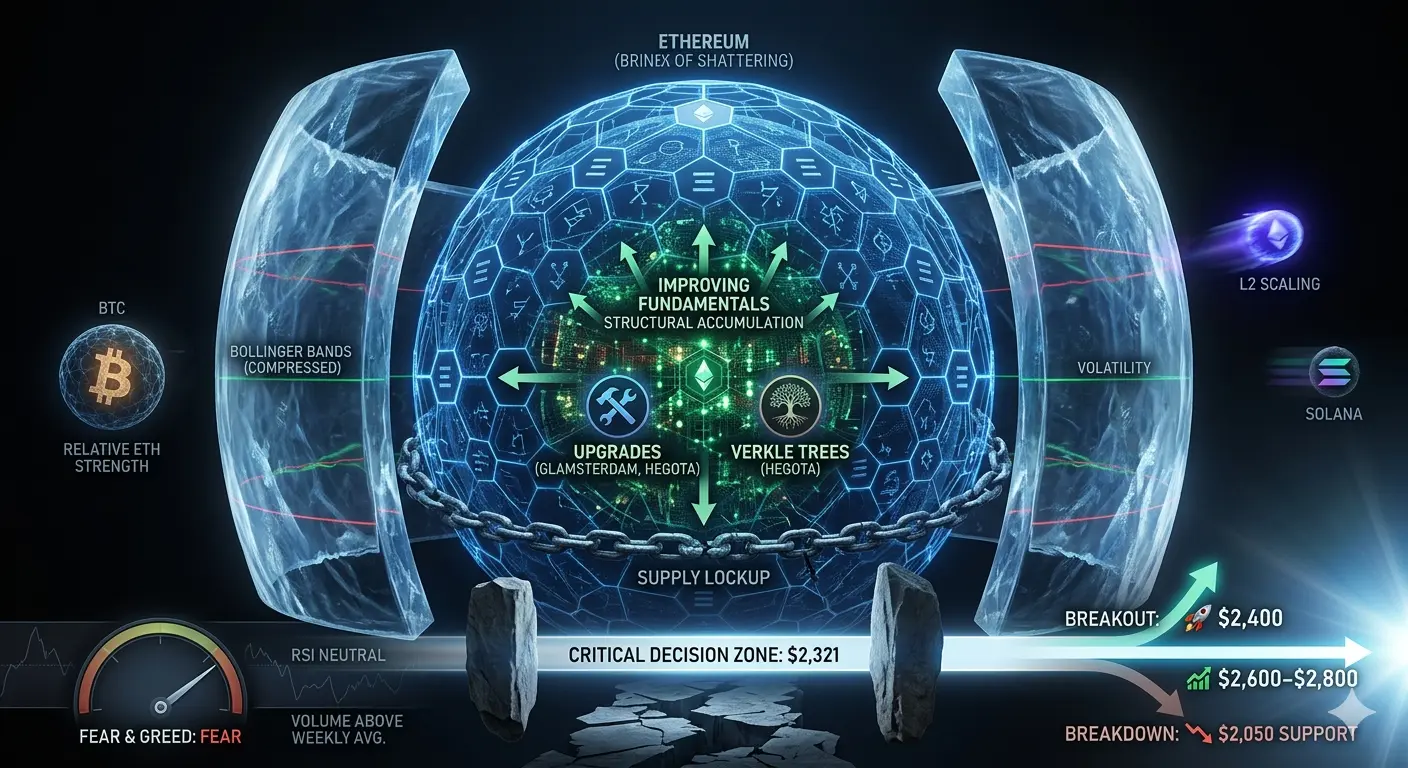
Right now, ETH is trading near the $2,300 region while volatility continues compressing into an increasingly tight range. Many traders are frustrated by the lack of explosive movement, but historically, Ethereum tends to produce its largest directional moves exactly when the market becomes impatient and interest fades.
That’s why the current setup matters.
Technically, Ethereum is showing a rare combination of stability, compression, and improving higher-timeframe structure all at the same time.
The daily moving averages remain aligned bullishly:
📈 MA7 above MA30
📈 MA30 above MA120
This type of structure usually signals that the broader trend is transitioning from recovery into continuation rather than exhaustion.
At the same time, both the daily and 4-hour SAR indicators remain positioned below price, confirming that buyers still maintain control across higher timeframes despite short-term hesitation.
But the single most important technical signal right now is volatility compression.
Ethereum’s Bollinger Bands have contracted to their narrowest range in roughly a month.
This is critical because markets rarely remain compressed for long periods. Tightening volatility almost always precedes aggressive expansion moves. The only uncertainty is direction.
And right now, several factors suggest Ethereum may be preparing for an upside breakout rather than a breakdown.
First:
volume behavior remains healthy.
ETH is not drifting upward on weak participation. Trading volume remains above the weekly average while price stabilizes near resistance. That “price-up + volume-up” combination typically signals real demand underneath the market rather than thin speculative movement.
Second:
Ethereum is quietly outperforming Bitcoin on shorter timeframes.
This may seem minor, but relative strength against BTC often becomes an early signal that capital is rotating back into higher-beta crypto assets.
Third:
market sentiment still hasn’t reached euphoric territory.
The Fear & Greed Index remains stuck near fear levels even while Ethereum’s structure improves. Historically, this creates one of the healthiest environments for continuation rallies because the market is still under-positioned and emotionally cautious.
Most explosive crypto rallies begin when disbelief is still dominant.
Another fascinating detail is the momentum structure itself.
Both the 15-minute and 4-hour charts are showing MACD bottom divergence — meaning momentum is improving underneath price even while ETH struggles to break higher immediately.
This type of divergence often appears before:
• relief rallies
• breakout attempts
• or short-term liquidity traps before expansion
Importantly, RSI conditions remain neutral across nearly all major timeframes.
That matters because Ethereum currently has room to move aggressively in either direction without immediately becoming technically overheated.
In other words:
the market is compressed, but not exhausted.
And that’s usually a dangerous combination for traders positioned incorrectly.
But the technical setup is only part of the story.
Fundamentally, Ethereum may be entering one of the strongest infrastructure-upgrade periods since The Merge.
The upcoming Glamsterdam and Hegota upgrades are far more important than many retail traders realize.
These upgrades are not cosmetic improvements.
They directly target Ethereum’s largest long-term challenges:
⚡ network efficiency
⚡ validator scalability
⚡ MEV optimization
⚡ state growth reduction
⚡ lighter client accessibility
The Hegota transition toward Verkle Trees in particular could become one of the most important architectural shifts in Ethereum’s history because it significantly improves how blockchain state data is stored and processed.
If execution succeeds, Ethereum’s long-term scalability narrative strengthens dramatically.
At the same time, institutional accumulation trends continue quietly building beneath the surface.
Large-scale ETH purchases, staking-focused ETF flows, and supply lockup dynamics are slowly reducing liquid circulating supply. Unlike previous speculative cycles driven mostly by leverage, this environment increasingly resembles structural accumulation.
And historically, supply compression combined with low sentiment often creates violent upside expansions once momentum finally returns.
However, Ethereum still faces serious structural challenges.
The biggest concern remains Layer-2 value extraction.
Ethereum successfully scaled through L2 ecosystems, but that success also redirected transaction fees and activity away from the Ethereum base layer itself. In many ways, Ethereum is now competing with parts of its own ecosystem for value capture.
At the same time, Solana continues growing aggressively in trading activity, user onboarding, and developer attention.
This means Ethereum is no longer operating without competition.
The market is now deciding whether Ethereum remains the dominant institutional smart-contract layer long term — or whether liquidity fragments across multiple ecosystems.
That’s why the current resistance zone near:
🎯 $2,321
is so important.
If ETH successfully breaks and holds above this level with strong volume confirmation, the path toward:
🚀 $2,400
then potentially:
🚀 $2,600–$2,800
opens much more aggressively.
But traders should also respect downside risk.
If Ethereum loses the $2,265 support region, the bullish structure begins weakening and opens the possibility for deeper retracements toward the broader $2,050 support zone.
Right now, Ethereum doesn’t look euphoric.
It looks compressed inside improving fundamentals, tightening supply conditions, and a strengthening higher-timeframe structure.
And historically, those are the exact environments where Ethereum tends to make its most important moves.
repost-content-media
  • Reward
  • 4
  • Repost
  • Share
ybaser:
LFG 🔥
View More
good
MrFlower_XingChen
#GateSquareMayTradingShare
The Global Market Is Entering A Dangerous Macro Repricing Phase — And Most Traders Still Think This Is “Normal Volatility”
What we are witnessing right now across global markets is no longer a simple headline reaction or short-term speculative panic.
This is becoming a full-scale macro repricing environment where geopolitical tension, liquidity instability, inflation expectations, and institutional capital rotation are all colliding at the same time.
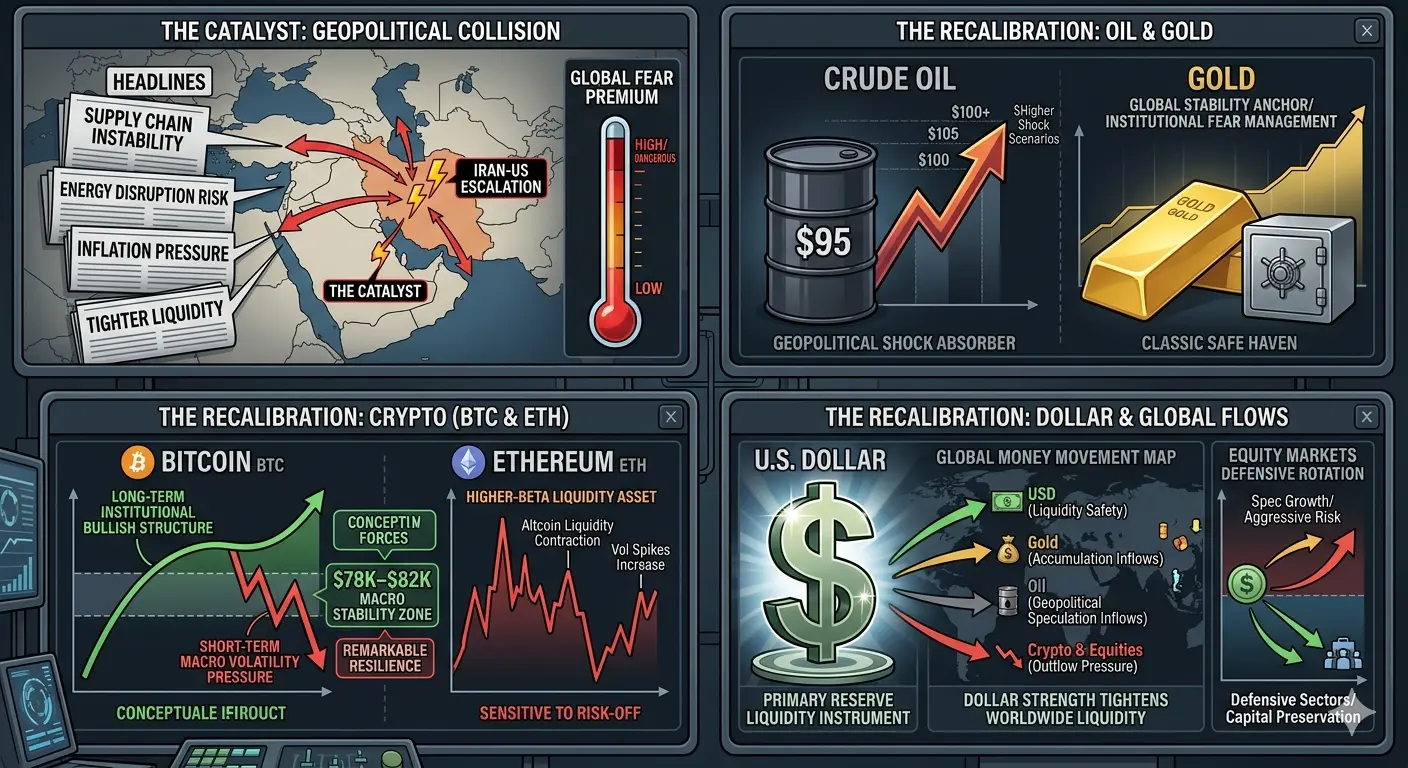
The escalation between Iran and the United States is acting as the catalyst, but the deeper story is how global financial systems respond when uncertainty suddenly becomes difficult to price.
Markets are forward-looking systems.
They do not wait for confirmed outcomes.
They begin repricing risk the moment probabilities shift.
And right now, probability models across global markets are rapidly adjusting for: ⚠️ supply chain instability
⚠️ energy disruption risk
⚠️ inflation pressure
⚠️ tighter liquidity conditions
⚠️ increased volatility across risk assets
That is why almost every major asset class is now reacting simultaneously rather than independently.
This is no longer just a crypto story.
It is a global macro story.
At the center of the current environment sits oil.
Crude oil around the $95 region is not simply reflecting normal supply-demand pricing anymore. It is trading with a geopolitical fear premium embedded directly into its structure.
And historically, oil becomes the first major asset to react aggressively during geopolitical escalation cycles because energy sits at the foundation of the global economic system.
When markets fear instability in the Middle East: • shipping risk increases
• insurance costs rise
• inflation expectations accelerate
• institutional hedging expands
• speculative futures positioning intensifies
That’s why oil can move violently once geopolitical pricing begins accelerating.
If tensions continue escalating, markets will immediately start discussing: 📈 $100 oil
📈 $105 oil
📈 potentially even higher shock scenarios
And that creates a chain reaction across every major financial market because higher energy costs tighten liquidity globally.
At the same time, gold is behaving exactly like a classic macro safe haven.
Gold’s current strength is not speculative excitement.
It is institutional fear management.
When uncertainty rises faster than confidence, capital naturally rotates toward assets perceived as long-term stores of value and stability anchors.
That’s exactly what gold is currently becoming inside the global system.
What makes the current environment especially fascinating is how Bitcoin is responding.
Bitcoin is no longer behaving like a pure speculative asset.
It now reacts as a hybrid macro instrument influenced by: • liquidity conditions
• institutional positioning
• macro headlines
• risk appetite
• and monetary expectations
This is a major structural evolution from earlier crypto cycles.
Right now, Bitcoin still holds its broader bullish structure, but short-term momentum is clearly being suppressed by macro fear and liquidity instability.
That’s why BTC currently feels trapped between two opposing forces: 📈 long-term institutional bullish structure
⚠️ short-term macro-driven volatility pressure
The key region around: 🎯 $78K–$82K
has effectively become Bitcoin’s macro stability zone.
If BTC holds above this region despite geopolitical stress, it signals remarkable structural resilience.
But if liquidity conditions deteriorate further and fear accelerates, deeper volatility expansions become increasingly likely before stabilization occurs.
Ethereum, meanwhile, is reacting with even greater sensitivity.
This is normal.
ETH historically behaves as a higher-beta liquidity asset, meaning it amplifies both bullish and bearish market conditions faster than Bitcoin.
That’s why Ethereum currently looks weaker structurally despite still maintaining long-term recovery potential.
In risk-off environments: • speculative inflows slow first
• altcoin liquidity contracts faster
• leverage participation declines
• volatility spikes increase
And Ethereum sits directly in the middle of those liquidity dynamics.
Another critically important factor many retail traders are underestimating right now is U.S. dollar strength.
During global uncertainty, capital almost always rotates toward the dollar because it remains the world’s primary reserve liquidity instrument.
That creates indirect pressure on virtually every risk-sensitive market: 📉 crypto
📉 equities
📉 growth sectors
📉 emerging markets
Because stronger dollar conditions effectively tighten financial liquidity worldwide.
This is one of the hidden macro forces suppressing crypto momentum right now even while long-term adoption narratives remain strong.
At the same time, equity markets are beginning to show classic defensive rotation behavior.
Capital is quietly moving away from: • speculative growth
• high-beta technology
• aggressive risk positioning
…and toward: • defensive sectors
• lower-volatility assets
• capital preservation structures
The same fear psychology affecting crypto is now spreading across traditional financial markets as well.
And psychologically, this is where markets become most unstable.
Not because fundamentals instantly collapse.
But because confidence weakens faster than liquidity can stabilize.
That creates: ⚠️ emotional price swings
⚠️ news-driven volatility
⚠️ fake breakouts
⚠️ panic liquidations
⚠️ unstable support/resistance behavior
Traditional technical analysis becomes less reliable during these periods because markets temporarily prioritize fear over structure.
And this is exactly why current capital flow behavior matters so much.
Right now, global money movement is becoming very clear:
💰 Gold → accumulation inflows
🛢 Oil → geopolitical speculation inflows
💵 U.S. Dollar → liquidity safety flows
📉 Crypto & equities → temporary outflow pressure
This rotation map explains the current macro environment more accurately than individual charts alone.
But there is one important historical reality traders should remember:
The most powerful long-term opportunities often begin during maximum uncertainty.
Markets tend to bottom emotionally before they bottom structurally.
And historically, the periods where fear dominates headlines, liquidity contracts, and volatility expands are often the same periods where institutional accumulation quietly begins underneath the surface before the next expansion cycle emerges.
Right now, global markets are not collapsing.
They are recalibrating.
Bitcoin and Ethereum are moving through a macro adjustment phase.
Gold is acting as the global stability anchor.
Oil is functioning as the geopolitical shock absorber.
And liquidity itself has become the single most important force driving market behavior.
Until geopolitical clarity improves and liquidity conditions stabilize, markets will likely remain: • highly volatile
• emotionally reactive
• macro-sensitive
• and heavily headline-driven
But historically, these are also the exact environments where the foundations of the next major cycle quietly begin forming.
#IranUSConflictEscalates
#WCTCTradingKingPK
repost-content-media
  • Reward
  • 2
  • Repost
  • Share
ybaser:
Just charge forward 👊
View More
MrFlower_XingChen
#GateSquareMayTradingShare
#OilPriceRollerCoaster
The global market has entered a phase where traditional technical analysis alone is no longer enough to explain price action. Markets are now being driven by a much larger force: geopolitical instability combined with inflation pressure and aggressive institutional repositioning.
At the center of this entire macro storm sits one asset: 🛢 crude oil.
And right now, oil is no longer behaving like a normal commodity market.
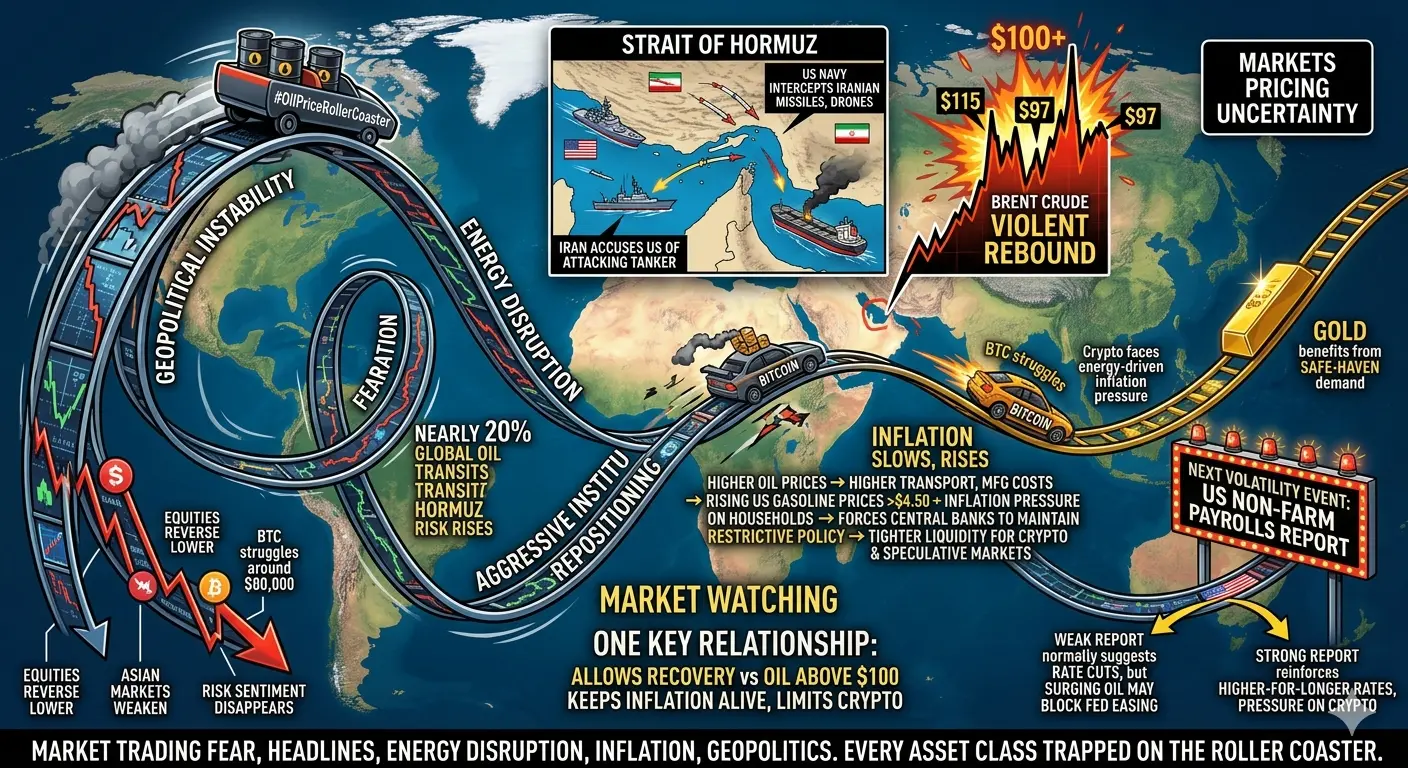
In just a matter of days, Brent crude surged toward $115, collapsed near $97, and then violently rebounded back above $100 after military escalation near the Strait of Hormuz intensified global energy fears. WTI mirrored the same extreme volatility, proving that traders are no longer pricing oil based purely on supply-demand fundamentals.
They are pricing uncertainty itself.
That distinction matters because uncertainty creates a completely different type of market behavior.
Traditional markets usually move based on economic expectations, earnings growth, interest rates, or supply data. But geopolitical markets move based on probability, fear, and reaction speed. One headline, one military incident, or one shipping disruption can instantly reprice billions of dollars across global assets.
The latest escalation dramatically demonstrated this reality.
After reports emerged that U.S. naval forces intercepted Iranian missiles, drones, and armed boats near the Strait of Hormuz — followed by retaliatory strikes against Iranian-linked positions — markets immediately shifted into full risk-off mode.
Oil spiked aggressively.
Equities reversed lower.
Asian markets weakened.
Crypto volatility accelerated.
Safe-haven demand surged.
And the reason the reaction was so violent is because the Strait of Hormuz is not just another shipping route.
It is one of the most strategically important energy corridors in the world.
Nearly 20% of global oil and gas transportation passes through that narrow channel.
That means markets are not simply reacting to military headlines. They are reacting to the possibility of global energy disruption itself.
Even the threat of disruption creates massive consequences: ⚠️ shipping insurance costs rise
⚠️ tanker traffic slows
⚠️ supply-chain fears increase
⚠️ inflation expectations accelerate
⚠️ speculative futures positioning expands
This is why oil volatility is now controlling the broader macro environment far more than many traders realize.
Because once oil prices rise aggressively, the impact spreads across the entire financial system almost immediately.
Higher oil prices increase: • transportation costs
• manufacturing expenses
• shipping costs
• airline fuel costs
• consumer gasoline prices
That inflation pressure then feeds directly into central bank policy expectations.
And this is where crypto markets become especially vulnerable.
Bitcoin and Ethereum are highly sensitive to global liquidity conditions. When inflation expectations rise because of energy shocks, central banks become less willing to ease monetary policy aggressively.
That means: 📉 tighter liquidity
📉 higher-for-longer interest rate expectations
📉 reduced speculative capital flows
📉 weaker risk appetite
This is exactly why Bitcoin continues struggling near the critical $80,000 region despite still maintaining its broader long-term bullish structure.
BTC is not collapsing structurally.
Instead, it is caught between two conflicting forces: 📈 institutional long-term accumulation
⚠️ short-term macro-driven liquidity pressure
Ethereum and altcoins face even greater pressure because higher-beta assets tend to react more aggressively whenever risk appetite deteriorates.
At the same time, gold continues behaving like the global stability anchor.
As uncertainty increases, institutional capital naturally rotates toward assets perceived as safer stores of value. Gold benefits directly from geopolitical fear, inflation uncertainty, and declining confidence in risk-sensitive markets.
This creates a very important macro relationship traders should watch carefully:
🛢 Oil above $100
→ inflation pressure stays elevated
→ Fed remains restrictive longer
→ liquidity weakens
→ crypto momentum struggles
🛢 Oil below $90
→ inflation fears cool
→ rate-cut expectations improve
→ liquidity conditions stabilize
→ crypto recovery becomes easier
Right now, markets are trapped directly between those two scenarios.
And unfortunately for traders, another major volatility catalyst is approaching: 📊 the U.S. Non-Farm Payrolls report.
Normally, weak employment data would increase expectations for Federal Reserve rate cuts and help risk assets recover.
But the current environment is not normal.
If oil prices continue surging, inflation pressure could remain elevated even during economic slowdown conditions. That would place the Federal Reserve in a difficult position where weakening growth still doesn’t fully justify aggressive easing.
On the other hand, strong employment data could reinforce the “higher-for-longer” interest rate narrative, creating additional pressure on crypto and equities.
That’s why the current market environment feels so unstable: both bullish and bearish economic outcomes can still trigger volatility.
And psychologically, this creates one of the most difficult trading environments possible.
Markets are no longer reacting purely to: • charts
• earnings
• technical levels
• or traditional macro data
They are reacting to: ⚠️ fear
⚠️ geopolitical escalation
⚠️ energy disruption risk
⚠️ inflation uncertainty
⚠️ liquidity instability
⚠️ headline-driven sentiment shifts
This type of environment creates rapid emotional repricing cycles where support and resistance levels can temporarily break far faster than traders expect.
Right now, the market is not trading certainty.
It is trading probability, fear, and reaction speed.
And until oil stabilizes and geopolitical tensions cool, every major asset class — from crypto to equities to commodities — remains connected to the same macro volatility roller coaster.
repost-content-media
  • Reward
  • 2
  • Repost
  • Share
ybaser:
Just charge forward 👊
View More
#GateSquareMayTradingShare
#OilPriceRollerCoaster
The global market has entered a phase where traditional technical analysis alone is no longer enough to explain price action. Markets are now being driven by a much larger force: geopolitical instability combined with inflation pressure and aggressive institutional repositioning.
At the center of this entire macro storm sits one asset: 🛢 crude oil.
And right now, oil is no longer behaving like a normal commodity market.
In just a matter of days, Brent crude surged toward $115, collapsed near $97, and then violently rebounded back above $100
BTC0.38%
ETH0.02%
MrFlower_XingChen
#GateSquareMayTradingShare
#OilPriceRollerCoaster
The global market has entered a phase where traditional technical analysis alone is no longer enough to explain price action. Markets are now being driven by a much larger force: geopolitical instability combined with inflation pressure and aggressive institutional repositioning.
At the center of this entire macro storm sits one asset: 🛢 crude oil.
And right now, oil is no longer behaving like a normal commodity market.
In just a matter of days, Brent crude surged toward $115, collapsed near $97, and then violently rebounded back above $100 after military escalation near the Strait of Hormuz intensified global energy fears. WTI mirrored the same extreme volatility, proving that traders are no longer pricing oil based purely on supply-demand fundamentals.
They are pricing uncertainty itself.
That distinction matters because uncertainty creates a completely different type of market behavior.
Traditional markets usually move based on economic expectations, earnings growth, interest rates, or supply data. But geopolitical markets move based on probability, fear, and reaction speed. One headline, one military incident, or one shipping disruption can instantly reprice billions of dollars across global assets.
The latest escalation dramatically demonstrated this reality.
After reports emerged that U.S. naval forces intercepted Iranian missiles, drones, and armed boats near the Strait of Hormuz — followed by retaliatory strikes against Iranian-linked positions — markets immediately shifted into full risk-off mode.
Oil spiked aggressively.
Equities reversed lower.
Asian markets weakened.
Crypto volatility accelerated.
Safe-haven demand surged.
And the reason the reaction was so violent is because the Strait of Hormuz is not just another shipping route.
It is one of the most strategically important energy corridors in the world.
Nearly 20% of global oil and gas transportation passes through that narrow channel.
That means markets are not simply reacting to military headlines. They are reacting to the possibility of global energy disruption itself.
Even the threat of disruption creates massive consequences: ⚠️ shipping insurance costs rise
⚠️ tanker traffic slows
⚠️ supply-chain fears increase
⚠️ inflation expectations accelerate
⚠️ speculative futures positioning expands
This is why oil volatility is now controlling the broader macro environment far more than many traders realize.
Because once oil prices rise aggressively, the impact spreads across the entire financial system almost immediately.
Higher oil prices increase: • transportation costs
• manufacturing expenses
• shipping costs
• airline fuel costs
• consumer gasoline prices
That inflation pressure then feeds directly into central bank policy expectations.
And this is where crypto markets become especially vulnerable.
Bitcoin and Ethereum are highly sensitive to global liquidity conditions. When inflation expectations rise because of energy shocks, central banks become less willing to ease monetary policy aggressively.
That means: 📉 tighter liquidity
📉 higher-for-longer interest rate expectations
📉 reduced speculative capital flows
📉 weaker risk appetite
This is exactly why Bitcoin continues struggling near the critical $80,000 region despite still maintaining its broader long-term bullish structure.
BTC is not collapsing structurally.
Instead, it is caught between two conflicting forces: 📈 institutional long-term accumulation
⚠️ short-term macro-driven liquidity pressure
Ethereum and altcoins face even greater pressure because higher-beta assets tend to react more aggressively whenever risk appetite deteriorates.
At the same time, gold continues behaving like the global stability anchor.
As uncertainty increases, institutional capital naturally rotates toward assets perceived as safer stores of value. Gold benefits directly from geopolitical fear, inflation uncertainty, and declining confidence in risk-sensitive markets.
This creates a very important macro relationship traders should watch carefully:
🛢 Oil above $100
→ inflation pressure stays elevated
→ Fed remains restrictive longer
→ liquidity weakens
→ crypto momentum struggles
🛢 Oil below $90
→ inflation fears cool
→ rate-cut expectations improve
→ liquidity conditions stabilize
→ crypto recovery becomes easier
Right now, markets are trapped directly between those two scenarios.
And unfortunately for traders, another major volatility catalyst is approaching: 📊 the U.S. Non-Farm Payrolls report.
Normally, weak employment data would increase expectations for Federal Reserve rate cuts and help risk assets recover.
But the current environment is not normal.
If oil prices continue surging, inflation pressure could remain elevated even during economic slowdown conditions. That would place the Federal Reserve in a difficult position where weakening growth still doesn’t fully justify aggressive easing.
On the other hand, strong employment data could reinforce the “higher-for-longer” interest rate narrative, creating additional pressure on crypto and equities.
That’s why the current market environment feels so unstable: both bullish and bearish economic outcomes can still trigger volatility.
And psychologically, this creates one of the most difficult trading environments possible.
Markets are no longer reacting purely to: • charts
• earnings
• technical levels
• or traditional macro data
They are reacting to: ⚠️ fear
⚠️ geopolitical escalation
⚠️ energy disruption risk
⚠️ inflation uncertainty
⚠️ liquidity instability
⚠️ headline-driven sentiment shifts
This type of environment creates rapid emotional repricing cycles where support and resistance levels can temporarily break far faster than traders expect.
Right now, the market is not trading certainty.
It is trading probability, fear, and reaction speed.
And until oil stabilizes and geopolitical tensions cool, every major asset class — from crypto to equities to commodities — remains connected to the same macro volatility roller coaster.
repost-content-media
  • Reward
  • 2
  • Repost
  • Share
ybaser:
Just charge forward 👊
View More
#GateSquareMayTradingShare
May Token Unlock Wave — What $41.8B in New Supply Could Mean for Crypto Markets
May 2026 is emerging as a structurally important month for the crypto market, not because of a single narrative or headline, but due to a large-scale supply event: a massive wave of token unlocks across multiple ecosystems. Rough estimates suggest that around $41.8 billion worth of tokens will be unlocked this month across roughly 140 different projects, creating one of the largest scheduled increases in circulating supply in recent cycles.
Token unlocks are a built-in mechanism in most
HYPE-3.38%
ENA-0.37%
ZRO2.16%
SUI13.67%
MrFlower_XingChen
#GateSquareMayTradingShare
May Token Unlock Wave — What $41.8B in New Supply Could Mean for Crypto Markets
May 2026 is emerging as a structurally important month for the crypto market, not because of a single narrative or headline, but due to a large-scale supply event: a massive wave of token unlocks across multiple ecosystems. Rough estimates suggest that around $41.8 billion worth of tokens will be unlocked this month across roughly 140 different projects, creating one of the largest scheduled increases in circulating supply in recent cycles.
Token unlocks are a built-in mechanism in most crypto projects where early investors, team members, and ecosystem contributors receive tokens that were previously locked under vesting schedules. Once these tokens become liquid, they can be traded freely in the open market. While this does not automatically lead to price declines, it introduces a key factor that markets must constantly reprice: potential selling pressure from newly unlocked supply.
What makes this month particularly important is the scale and distribution of these unlocks. Instead of being concentrated in a single asset, the unlock pressure is spread across multiple mid-cap and infrastructure-focused tokens. This includes projects like Hyperliquid, Ethena, LayerZero, Sui, Arbitrum, and others, each contributing varying levels of new circulating supply. In some cases, unlocks represent a significant percentage of existing supply, which can meaningfully affect short-term price dynamics if demand does not absorb the new tokens efficiently.
From a market structure perspective, token unlocks function similarly to lock-up expirations in traditional equity markets. When early shareholders are suddenly allowed to sell after an IPO lock-up period, markets often experience increased volatility as supply conditions shift. Crypto follows the same principle, but with a key difference: unlock schedules in crypto are often more concentrated and less smoothly distributed, which can amplify short-term price reactions.
The impact of these events is heavily dependent on broader market conditions. In strong bullish phases, unlocks are often absorbed relatively easily as new buyers step in to match increased supply. In contrast, during uncertain or risk-off environments, unlock events can act as catalysts for sharper corrections because liquidity is already thin and investor confidence is weaker. This makes timing and macro context extremely important when evaluating unlock risk.
This May’s unlock cycle is also occurring alongside broader macro uncertainty, including geopolitical tensions, fluctuating inflation expectations, and inconsistent liquidity flows across global markets. These conditions reduce the market’s ability to absorb new supply smoothly, especially in smaller and mid-cap tokens where liquidity depth is limited compared to major assets like Bitcoin and Ethereum.
For major cryptocurrencies such as BTC and ETH, the direct impact of token unlocks is relatively limited. Their liquidity depth and institutional participation help absorb supply shocks more efficiently. However, sentiment spillovers from mid-cap volatility can still influence broader market behavior, particularly during periods of risk aversion.
One of the most important aspects to monitor is the percentage of circulating supply being unlocked. Smaller unlock percentages (under 5%) typically have minimal impact, while larger unlock events exceeding 10% can create noticeable price pressure, especially if early investors choose to exit positions quickly. The actual outcome depends on whether long-term demand is strong enough to counterbalance new supply entering the market.
Another key factor is project quality. Strong fundamental projects with active ecosystems, real usage, and sustained development activity often recover quickly after unlock events because new supply is absorbed by organic demand. Weaker projects without strong user growth or utility tend to experience more prolonged downside pressure as selling outweighs buying interest.
Market sentiment also plays a major role. In bullish environments, unlocks are often seen as opportunities for accumulation during temporary dips. In bearish or uncertain conditions, the same unlocks can trigger sharper corrections as investors become more sensitive to supply increases.
Overall, the May 2026 token unlock cycle should not be viewed as a single directional catalyst, but rather as a volatility amplifier layered onto an already complex macro environment. It introduces short-term supply pressure across multiple assets while testing the underlying demand strength of each ecosystem.
In the broader context, this phase represents an important stress test for the crypto market. If liquidity remains strong, the market will likely absorb these unlocks with limited disruption. If liquidity weakens further, volatility could increase significantly across mid-cap tokens, even if major assets remain relatively stable.
Ultimately, token unlocks are not inherently bearish or bullish—they simply reveal the balance between supply entering the market and demand willing to absorb it. And in May 2026, that balance will be tested at scale.
repost-content-media
  • Reward
  • 4
  • Repost
  • Share
ybaser:
Just charge forward 👊
View More
#GateSquareMayTradingShare
BTC Market Structure Update — Bull Market Continuation or Late-Cycle Warning?
Bitcoin is currently trading around the $80,000 region again, and the market is entering one of the most psychologically important phases of the entire cycle. Price has reclaimed a major macro level, institutional participation remains strong, ETF inflows continue building, and regulatory momentum in the United States is improving. On the surface, everything appears bullish.
But beneath that strength, momentum signals are beginning to show a more complicated picture.
BTC is now trading nea
BTC0.38%
MrFlower_XingChen
#GateSquareMayTradingShare
BTC Market Structure Update — Bull Market Continuation or Late-Cycle Warning?
Bitcoin is currently trading around the $80,000 region again, and the market is entering one of the most psychologically important phases of the entire cycle. Price has reclaimed a major macro level, institutional participation remains strong, ETF inflows continue building, and regulatory momentum in the United States is improving. On the surface, everything appears bullish.
But beneath that strength, momentum signals are beginning to show a more complicated picture.
BTC is now trading near $80,378, posting roughly +0.89% gains over the past 24 hours. The broader trend structure remains positive across nearly every major timeframe: • +2.3% over 7 days
• +10.2% over 30 days
• +14.6% over 90 days
The recovery above the $80K psychological zone is significant because this level represents more than simple price action. It acts as a sentiment threshold for both institutional and retail participants. Historically, reclaiming major round-number resistance zones tends to attract renewed attention, increase speculative participation, and strengthen bullish narratives across the market.
However, markets rarely move in straight lines — and the current structure reflects exactly that tension.
Technical Structure — Strong Trend, Slowing Momentum
From a pure trend perspective, Bitcoin still looks structurally bullish.
Across both short-term and higher-timeframe charts, moving averages remain aligned in classic bullish formation: MA7 > MA30 > MA120.
ADX trend strength readings also continue supporting the broader uptrend, suggesting that momentum remains intact from a structural standpoint rather than simply being driven by short-term speculation.
But there are now visible signs that the rally may be entering a more mature phase.
The daily chart is beginning to show MACD bearish divergence — one of the most closely watched momentum warning signals in technical analysis. This occurs when price continues printing higher highs while momentum indicators begin weakening underneath the surface.
In simple terms: price is still rising, but the force behind the move is slowing.
At the same time, the Commodity Channel Index (CCI) is sitting in overbought territory, reinforcing the idea that BTC may be approaching short-term exhaustion conditions after its recent recovery.
This does not automatically signal a major reversal. In strong bull markets, overbought conditions can persist for extended periods. However, it does increase the probability of: • consolidation
• volatility expansion
• temporary pullbacks
• liquidity sweeps before continuation
Meanwhile, the shorter 15-minute timeframe presents a very different picture. Williams %R readings suggest short-term oversold conditions, implying that local dips may still attract buyers quickly within the broader uptrend.
This creates a conflicting but important structure: Higher timeframe momentum is slowing, while short-term traders continue buying dips aggressively.
That type of environment often produces choppy, headline-driven price action before the next major directional move emerges.
ETF Flows Continue Supporting the Market
One of the strongest pillars supporting Bitcoin right now remains institutional demand through spot ETFs.
The market has now seen multiple consecutive weeks of positive net inflows into U.S. Bitcoin ETFs, signaling that institutional accumulation has not disappeared despite macro uncertainty and elevated volatility.
This is important because ETF demand fundamentally changes the supply-demand structure of Bitcoin.
Unlike previous retail-dominated cycles, institutional accumulation tends to: • reduce circulating liquid supply
• create slower but more stable buying pressure
• support higher price floors during corrections
• reduce panic-selling intensity
As long as ETF inflows remain structurally positive, BTC maintains an important macro tailwind underneath the market.
Market Sentiment — Bullish Price, Fearful Psychology
One of the most fascinating aspects of the current cycle is the disconnect between price action and sentiment.
Despite Bitcoin trading back above $80K, the Fear & Greed Index remains around 38 — still inside fear territory.
Historically, truly euphoric bull market tops usually occur when: • leverage becomes excessive
• retail speculation explodes
• sentiment reaches extreme greed
• volatility compresses into complacency
None of those conditions fully exist right now.
Instead, the current environment feels cautious, hesitant, and macro-sensitive.
Social sentiment remains mostly bullish: • 61% positive
• 21% negative
But the broader market still appears psychologically defensive due to: • geopolitical uncertainty
• inflation concerns
• Federal Reserve policy risks
• oil-driven macro volatility
This creates what many analysts describe as a “reluctant bull market” — a market moving higher while participants remain emotionally unconvinced.
Historically, that type of structure often supports continuation rather than immediate collapse because positioning is not yet overcrowded.
Where Are We in the Bitcoin Cycle?
This is currently the biggest debate across crypto markets.
Bitcoin is now roughly two years removed from the 2022 cycle bottom, placing it historically inside the later stages of a post-bear-market recovery phase.
The bullish argument remains strong: • historical halving cycles still support higher targets
• ETF adoption is structurally bullish
• institutional integration continues expanding
• regulatory progress is improving sentiment
• long-term supply remains constrained
Many cycle analysts continue targeting the Fibonacci 2.618 extension zone near $130K+ as a potential late-cycle target if momentum accelerates later this year.
At the same time, caution is increasing among traders who believe the cycle may already be maturing faster than previous ones.
Their concerns focus on: • slowing momentum
• bearish MACD divergence
• weakening speculative participation
• lower retail euphoria compared to past peaks
• increasing macro dependence
This suggests Bitcoin may be transitioning from an aggressive expansion phase into a slower, more volatile late-cycle environment.
Key Levels That Matter Next
The immediate battlefield for bulls remains the $81K–$82K region.
If BTC can establish strong daily closes above this zone with healthy volume participation, momentum could expand toward: • $85K
• $90K
• potentially $95K in stronger macro conditions
However, if rejection continues near current resistance levels while momentum weakens further, the market could enter a deeper correction phase.
Key downside support zones include: • $78K
• $76K
• $72K
• and potentially the broader $60K region in a stronger risk-off scenario
Importantly, even a move toward the $60K area would not necessarily destroy the broader bullish structure. Bitcoin historically experiences deep corrections during every major bull cycle before continuation resumes.
Final Outlook
Bitcoin remains structurally bullish, but the market is no longer in the early easy phase of the cycle.
Momentum is slowing.
Macro conditions remain unstable.
Institutional demand is supporting price.
But sentiment still lacks true conviction.
This creates a market environment where: • upside continuation remains possible
• volatility remains elevated
• corrections become more aggressive
• and macro headlines increasingly control short-term direction
The most likely scenario right now is not immediate collapse or explosive euphoria — but a cautious, liquidity-sensitive grind higher with periodic sharp pullbacks along the way.
The next major move will likely depend on whether Bitcoin can convert the $81K–$82K zone into confirmed support. If that happens, the path toward higher cycle targets remains open.
If not, the market may first need a deeper reset before the next expansion phase begins.
$BTC
repost-content-media
  • Reward
  • 5
  • Repost
  • Share
ybaser:
Just charge forward 👊
View More
#GateSquareMayTradingShare
BTC Market Structure Update — Bull Market Continuation or Late-Cycle Warning?
Bitcoin is currently trading around the $80,000 region again, and the market is entering one of the most psychologically important phases of the entire cycle. Price has reclaimed a major macro level, institutional participation remains strong, ETF inflows continue building, and regulatory momentum in the United States is improving. On the surface, everything appears bullish.
But beneath that strength, momentum signals are beginning to show a more complicated picture.
BTC is now trading nea
BTC0.38%
MrFlower_XingChen
#GateSquareMayTradingShare
BTC Market Structure Update — Bull Market Continuation or Late-Cycle Warning?
Bitcoin is currently trading around the $80,000 region again, and the market is entering one of the most psychologically important phases of the entire cycle. Price has reclaimed a major macro level, institutional participation remains strong, ETF inflows continue building, and regulatory momentum in the United States is improving. On the surface, everything appears bullish.
But beneath that strength, momentum signals are beginning to show a more complicated picture.
BTC is now trading near $80,378, posting roughly +0.89% gains over the past 24 hours. The broader trend structure remains positive across nearly every major timeframe: • +2.3% over 7 days
• +10.2% over 30 days
• +14.6% over 90 days
The recovery above the $80K psychological zone is significant because this level represents more than simple price action. It acts as a sentiment threshold for both institutional and retail participants. Historically, reclaiming major round-number resistance zones tends to attract renewed attention, increase speculative participation, and strengthen bullish narratives across the market.
However, markets rarely move in straight lines — and the current structure reflects exactly that tension.
Technical Structure — Strong Trend, Slowing Momentum
From a pure trend perspective, Bitcoin still looks structurally bullish.
Across both short-term and higher-timeframe charts, moving averages remain aligned in classic bullish formation: MA7 > MA30 > MA120.
ADX trend strength readings also continue supporting the broader uptrend, suggesting that momentum remains intact from a structural standpoint rather than simply being driven by short-term speculation.
But there are now visible signs that the rally may be entering a more mature phase.
The daily chart is beginning to show MACD bearish divergence — one of the most closely watched momentum warning signals in technical analysis. This occurs when price continues printing higher highs while momentum indicators begin weakening underneath the surface.
In simple terms: price is still rising, but the force behind the move is slowing.
At the same time, the Commodity Channel Index (CCI) is sitting in overbought territory, reinforcing the idea that BTC may be approaching short-term exhaustion conditions after its recent recovery.
This does not automatically signal a major reversal. In strong bull markets, overbought conditions can persist for extended periods. However, it does increase the probability of: • consolidation
• volatility expansion
• temporary pullbacks
• liquidity sweeps before continuation
Meanwhile, the shorter 15-minute timeframe presents a very different picture. Williams %R readings suggest short-term oversold conditions, implying that local dips may still attract buyers quickly within the broader uptrend.
This creates a conflicting but important structure: Higher timeframe momentum is slowing, while short-term traders continue buying dips aggressively.
That type of environment often produces choppy, headline-driven price action before the next major directional move emerges.
ETF Flows Continue Supporting the Market
One of the strongest pillars supporting Bitcoin right now remains institutional demand through spot ETFs.
The market has now seen multiple consecutive weeks of positive net inflows into U.S. Bitcoin ETFs, signaling that institutional accumulation has not disappeared despite macro uncertainty and elevated volatility.
This is important because ETF demand fundamentally changes the supply-demand structure of Bitcoin.
Unlike previous retail-dominated cycles, institutional accumulation tends to: • reduce circulating liquid supply
• create slower but more stable buying pressure
• support higher price floors during corrections
• reduce panic-selling intensity
As long as ETF inflows remain structurally positive, BTC maintains an important macro tailwind underneath the market.
Market Sentiment — Bullish Price, Fearful Psychology
One of the most fascinating aspects of the current cycle is the disconnect between price action and sentiment.
Despite Bitcoin trading back above $80K, the Fear & Greed Index remains around 38 — still inside fear territory.
Historically, truly euphoric bull market tops usually occur when: • leverage becomes excessive
• retail speculation explodes
• sentiment reaches extreme greed
• volatility compresses into complacency
None of those conditions fully exist right now.
Instead, the current environment feels cautious, hesitant, and macro-sensitive.
Social sentiment remains mostly bullish: • 61% positive
• 21% negative
But the broader market still appears psychologically defensive due to: • geopolitical uncertainty
• inflation concerns
• Federal Reserve policy risks
• oil-driven macro volatility
This creates what many analysts describe as a “reluctant bull market” — a market moving higher while participants remain emotionally unconvinced.
Historically, that type of structure often supports continuation rather than immediate collapse because positioning is not yet overcrowded.
Where Are We in the Bitcoin Cycle?
This is currently the biggest debate across crypto markets.
Bitcoin is now roughly two years removed from the 2022 cycle bottom, placing it historically inside the later stages of a post-bear-market recovery phase.
The bullish argument remains strong: • historical halving cycles still support higher targets
• ETF adoption is structurally bullish
• institutional integration continues expanding
• regulatory progress is improving sentiment
• long-term supply remains constrained
Many cycle analysts continue targeting the Fibonacci 2.618 extension zone near $130K+ as a potential late-cycle target if momentum accelerates later this year.
At the same time, caution is increasing among traders who believe the cycle may already be maturing faster than previous ones.
Their concerns focus on: • slowing momentum
• bearish MACD divergence
• weakening speculative participation
• lower retail euphoria compared to past peaks
• increasing macro dependence
This suggests Bitcoin may be transitioning from an aggressive expansion phase into a slower, more volatile late-cycle environment.
Key Levels That Matter Next
The immediate battlefield for bulls remains the $81K–$82K region.
If BTC can establish strong daily closes above this zone with healthy volume participation, momentum could expand toward: • $85K
• $90K
• potentially $95K in stronger macro conditions
However, if rejection continues near current resistance levels while momentum weakens further, the market could enter a deeper correction phase.
Key downside support zones include: • $78K
• $76K
• $72K
• and potentially the broader $60K region in a stronger risk-off scenario
Importantly, even a move toward the $60K area would not necessarily destroy the broader bullish structure. Bitcoin historically experiences deep corrections during every major bull cycle before continuation resumes.
Final Outlook
Bitcoin remains structurally bullish, but the market is no longer in the early easy phase of the cycle.
Momentum is slowing.
Macro conditions remain unstable.
Institutional demand is supporting price.
But sentiment still lacks true conviction.
This creates a market environment where: • upside continuation remains possible
• volatility remains elevated
• corrections become more aggressive
• and macro headlines increasingly control short-term direction
The most likely scenario right now is not immediate collapse or explosive euphoria — but a cautious, liquidity-sensitive grind higher with periodic sharp pullbacks along the way.
The next major move will likely depend on whether Bitcoin can convert the $81K–$82K zone into confirmed support. If that happens, the path toward higher cycle targets remains open.
If not, the market may first need a deeper reset before the next expansion phase begins.
$BTC
repost-content-media
  • Reward
  • 4
  • Repost
  • Share
ybaser:
Just charge forward 👊
View More
Crypto Is No Longer Trading Alone — Wall Street Is Driving the Entire Market
The relationship between traditional financial markets and crypto has changed dramatically over the past few years. What was once considered an “alternative” asset class operating outside the traditional system is now increasingly behaving like a direct extension of global macro markets.
This week perfectly demonstrated that shift.
The S&P 500 and Nasdaq pushed toward fresh all-time highs, fueled by continued enthusiasm around artificial intelligence, strong corporate earnings, resilient economic data, and easing geop
BTC0.38%
SOL1.76%
MrFlower_XingChen
Crypto Is No Longer Trading Alone — Wall Street Is Driving the Entire Market
The relationship between traditional financial markets and crypto has changed dramatically over the past few years. What was once considered an “alternative” asset class operating outside the traditional system is now increasingly behaving like a direct extension of global macro markets.
This week perfectly demonstrated that shift.
The S&P 500 and Nasdaq pushed toward fresh all-time highs, fueled by continued enthusiasm around artificial intelligence, strong corporate earnings, resilient economic data, and easing geopolitical fears tied to improving expectations surrounding potential US-Iran negotiations. At the same time, oil prices cooled sharply as traders reduced geopolitical risk premiums, helping improve broader market sentiment and reigniting risk appetite across global financial markets.
Crypto reacted almost immediately.
Bitcoin climbed back above the psychologically critical $80,000 region while major altcoins also accelerated higher. Solana posted particularly strong gains as speculative appetite returned across high-beta digital assets. None of this happened in isolation. The crypto market was responding to the exact same macro forces currently driving equities.
And that reveals something extremely important about the current cycle.
The correlation between Bitcoin and the S&P 500 has now risen toward historically extreme levels. In practical terms, Bitcoin is increasingly moving in the same direction as traditional equity markets rather than behaving independently. Instead of functioning primarily as “digital gold” or a hedge against the traditional financial system, BTC is currently acting much more like a high-volatility technology asset deeply connected to liquidity conditions, institutional risk appetite, and macroeconomic expectations.
This shift changes how crypto must be analyzed.
For years, many investors believed Bitcoin would eventually decouple from equities and behave as a defensive store of value during economic instability. But in the current environment, crypto is trading more like a leveraged version of the Nasdaq. When stocks rally because investors feel optimistic about growth, liquidity, and future earnings, crypto tends to rally even harder. When stocks fall due to tightening liquidity or macro fear, crypto often experiences amplified downside volatility.
The reason behind this transformation is institutionalization.
As institutional capital entered the crypto market through ETFs, hedge funds, family offices, and corporate treasury exposure, crypto became increasingly integrated into the same liquidity cycle that drives equities. Large institutions do not treat Bitcoin as a completely isolated system. Instead, they manage it alongside other high-risk assets within broader portfolio strategies tied to interest rates, inflation expectations, liquidity conditions, and macroeconomic trends.
This is why Federal Reserve policy now influences Bitcoin almost as strongly as it influences growth stocks.
Lower interest rates and expanding liquidity generally support crypto because investors become more willing to take risk. Higher rates and tighter liquidity conditions usually pressure crypto because speculative capital becomes more defensive. The current market environment reflects exactly that relationship.
The recent equity rally has been powered by several major macro themes simultaneously:
• Artificial intelligence optimism continues driving technology sector momentum
• Corporate earnings remain stronger than many expected
• Labor market data still supports economic resilience
• Falling oil prices are easing inflation fears
• Geopolitical tensions temporarily appear less severe
• Expectations for policy stability remain supportive for risk assets
All of these conditions create a classic “risk-on” environment where investors aggressively rotate capital toward growth-oriented and speculative assets.
Crypto naturally benefits from that environment.
Bitcoin reclaiming the $80K level is not just a technical event. Psychologically, it reinforces market confidence and attracts renewed attention from both institutional and retail participants. Once BTC stabilizes above major psychological zones, speculative appetite typically expands across the broader digital asset market, allowing altcoins to outperform on a relative basis.
However, there is a more important structural implication that many investors still underestimate.
If Bitcoin continues maintaining extremely high correlation with equities, the traditional diversification argument becomes much weaker. Holding both stocks and crypto no longer provides the same level of portfolio separation many investors expected during earlier cycles.
Instead of acting as a hedge against traditional market weakness, crypto increasingly amplifies existing macro exposure.
This means that if equity markets eventually experience a major correction caused by inflation surprises, weaker earnings, geopolitical escalation, or renewed monetary tightening, crypto could face even sharper downside volatility due to its higher-beta nature.
In other words, crypto currently benefits when Wall Street feels confident — but it also becomes vulnerable when Wall Street turns defensive.
That creates a very different market structure compared to previous cycles.
During earlier years, crypto was heavily driven by internal industry narratives such as adoption, blockchain innovation, mining cycles, and retail speculation. Today, macroeconomics plays a much larger role. Treasury yields, central bank policy, oil prices, labor market data, and geopolitical developments now directly influence crypto liquidity behavior.
The market is no longer trading purely on blockchain fundamentals.
It is trading global liquidity.
This is why traders are now paying close attention to several critical macro catalysts moving forward.
Federal Reserve policy remains one of the biggest drivers. If inflation continues cooling and economic growth stabilizes, markets may begin pricing future rate cuts more aggressively, supporting additional upside for equities and crypto alike. On the other hand, if inflation reaccelerates or economic conditions weaken unexpectedly, risk assets could face renewed pressure.
Regulatory developments also remain important. Progress around crypto market structure legislation, including broader regulatory clarity initiatives in the United States, could strengthen institutional confidence and accelerate long-term adoption trends. Institutional capital prefers predictable legal environments, and clearer regulation could significantly expand participation over time.
At the same time, traders are watching whether Bitcoin’s correlation with equities eventually stabilizes or begins decoupling again. Some long-term Bitcoin supporters still believe BTC could eventually re-establish itself as an independent macro asset once adoption matures further and sovereign accumulation increases. But at this stage of the cycle, that decoupling has not fully materialized.
For now, crypto remains deeply tied to broader financial market behavior.
The current rally in stocks is helping support Bitcoin and altcoins because liquidity conditions, investor optimism, and macro sentiment remain constructive. But the same relationship also means crypto’s future direction remains increasingly dependent on the same macro forces controlling Wall Street.
The market has evolved.
Crypto is no longer standing outside the traditional financial system.
It is now moving with it — and often faster.#GateSquareMayTradingShare
repost-content-media
  • Reward
  • 4
  • Repost
  • Share
ybaser:
Just charge forward 👊
View More
#GateSquareMayTradingShare
BTC Holds Above $80K — Strong Trend Structure Meets Growing Momentum Exhaustion
Bitcoin continues trading above the psychologically critical $80,000 level, currently holding near $80,477 after posting a modest 24-hour gain of roughly 0.9%. While the headline move appears relatively calm, the broader market structure reveals a far more important story developing beneath the surface.
Over the past several months, Bitcoin has steadily rebuilt bullish momentum despite repeated macroeconomic uncertainty, geopolitical volatility, and tightening global liquidity conditions
BTC0.38%
ADX-1.74%
MrFlower_XingChen
#GateSquareMayTradingShare
BTC Holds Above $80K — Strong Trend Structure Meets Growing Momentum Exhaustion
Bitcoin continues trading above the psychologically critical $80,000 level, currently holding near $80,477 after posting a modest 24-hour gain of roughly 0.9%. While the headline move appears relatively calm, the broader market structure reveals a far more important story developing beneath the surface.
Over the past several months, Bitcoin has steadily rebuilt bullish momentum despite repeated macroeconomic uncertainty, geopolitical volatility, and tightening global liquidity conditions. BTC is now up more than 2.4% over the last 7 days, over 10% across the past month, and nearly 15% over the last 90 days. This confirms that the broader recovery trend remains intact and that institutional participation continues supporting the market at higher price levels.
The reclaim of the $80K region is particularly important from a psychological perspective. Major round-number levels often act as emotional battlegrounds between buyers and sellers, and Bitcoin spending time above this area reinforces confidence that the broader market structure has improved significantly compared to earlier phases of the cycle.
Technically, Bitcoin still maintains a clearly bullish structure across multiple timeframes. On both the short-term 15-minute charts and the broader daily timeframe, moving averages remain fully aligned in bullish order, with MA7 positioned above MA30 and MA30 above MA120. This type of alignment usually reflects sustained trend continuation rather than temporary speculative spikes.
Momentum indicators also continue supporting the bullish case in the near term. The Positive Directional Indicator (PDI) remains well above the Negative Directional Indicator (MDI), while ADX readings near the low-30 range confirm that directional trend strength remains healthy. On shorter timeframes, the Parabolic SAR indicator continues positioning below recent price lows, functioning as a trailing support structure for bullish momentum.
In simple terms, the underlying trend itself has not broken.
However, while the structure remains bullish, momentum quality is beginning to weaken — and that distinction matters significantly.
The most important caution signal currently developing is the daily MACD bearish divergence. Bitcoin recently pushed toward a fresh local high near $80,665, yet the MACD histogram simultaneously weakened considerably, declining from 75.3 toward 35.6 while the DIF line also lost strength.
This type of divergence often signals that buying momentum is beginning to slow even while price continues drifting upward. Historically, these conditions frequently appear during later stages of rallies when markets continue climbing primarily through residual momentum rather than expanding buying pressure.
At the same time, the Commodity Channel Index has now entered overbought territory above 100. Overbought readings alone do not automatically signal reversals, especially during strong uptrends, but they do indicate that price may be becoming stretched relative to recent averages. Markets in overbought conditions often become increasingly vulnerable to consolidation phases, volatility spikes, or liquidity-driven pullbacks.
The encouraging factor for bulls is that Bitcoin’s recent advance still appears supported by healthy participation. Trading volume over the past 24 hours remains significantly above the recent average while price continues rising. This creates a strong “price-up with volume-up” structure, which typically reflects genuine capital inflows rather than weak speculative movement.
Volume confirmation is critical because sustainable rallies require real participation from both institutional and spot-market buyers. Thin rallies with declining participation often collapse quickly, while expanding volume tends to strengthen structural stability.
Institutional flow dynamics, however, are beginning to show signs of cooling.
Earlier this month, U.S. spot Bitcoin ETFs experienced a powerful surge in net inflows totaling more than $1 billion across several consecutive sessions. Those inflows played a major role in helping Bitcoin reclaim the $80K level and reinforced the narrative that institutional demand remains one of the strongest long-term drivers behind the current cycle.
But after May 7, ETF flows started turning negative again.
This shift does not necessarily imply that institutional investors are abandoning Bitcoin. Instead, it suggests that large buyers may be becoming more selective and cautious after the recent rally. Institutions often reduce aggressive accumulation near key resistance zones while waiting for either confirmation breakouts or better re-entry opportunities during pullbacks.
Another notable development came from Sequans, the French publicly listed company that recently sold over 1,000 BTC to reduce debt and support share buybacks. While the sale itself is not large enough to alter Bitcoin’s macro structure, it highlights an important reality of the current cycle: not every corporate holder is aggressively accumulating at current levels. Some firms are prioritizing balance sheet optimization and financial stability instead of expanding crypto exposure.
This creates a more balanced market environment compared to earlier phases dominated by one-sided institutional buying narratives.
Sentiment conditions also remain unusually cautious considering Bitcoin’s recovery strength.
The Fear & Greed Index continues sitting near 38, firmly inside fear territory despite BTC reclaiming one of the most psychologically important price zones in the market. Historically, major breakouts above key resistance levels often trigger euphoric behavior, aggressive leverage expansion, and rapidly accelerating optimism.
That is not happening right now.
Instead, the market feels hesitant and cautious. Social sentiment remains net bullish overall, with positive commentary significantly outweighing bearish discussion, but investor confidence still appears fragile. Discussion activity remains stable rather than euphoric, and many larger market participants appear to be waiting for stronger confirmation before increasing exposure aggressively.
This creates what many traders would describe as a “skeptical rally.”
Interestingly, skeptical rallies can often last longer than euphoric ones because the market remains under-positioned. Excessive optimism typically creates crowded trades vulnerable to violent corrections, while cautious participation allows trends to extend more gradually over time.
Macro conditions remain the most important external variable.
Bitcoin is no longer trading independently from the broader financial system. Treasury yields, Federal Reserve expectations, geopolitical tensions, ETF flows, oil prices, and equity market performance now heavily influence crypto liquidity behavior. BTC increasingly behaves like a high-beta macro asset deeply tied to global risk appetite.
This means Bitcoin’s next major move may depend less on internal crypto narratives and more on overall liquidity conditions across traditional financial markets.
If macro conditions remain stable, institutional inflows recover, and risk appetite stays constructive, Bitcoin could continue pushing toward higher resistance zones near $82K and eventually $85K. However, if liquidity conditions weaken or macro volatility returns aggressively, the current momentum divergences suggest BTC could experience a meaningful consolidation phase or corrective pullback before continuation higher.
The $80K region itself now becomes one of the most important structural support zones in the market.
As long as Bitcoin holds above this level, the broader bullish structure remains intact. But failure to defend the region could quickly shift short-term psychology and trigger deeper retracements as traders reduce risk exposure.
Right now, Bitcoin is not showing signs of structural weakness.
But it is showing signs that momentum is slowing while caution quietly increases beneath the surface.
That combination often defines the most critical transition phases of a market cycle.
repost-content-media
  • Reward
  • 3
  • Repost
  • Share
ybaser:
Just charge forward 👊
View More
MrFlower_XingChen
#JapanTokenizesGovernmentBonds Japan is currently moving into one of the most important financial infrastructure upgrades in decades by tokenizing its government bond system, and this is starting to reshape how global markets view traditional sovereign debt markets. The core idea is not just a minor technical upgrade, but a shift toward putting Japanese Government Bonds (JGBs) onto blockchain-based systems where trading, settlement, and collateral management can happen in a more automated and continuous way.
At the center of this development is the plan to enable 24/7 trading and near-instant settlement of government bonds using blockchain systems and tokenized securities. Instead of the traditional model where bonds settle on a delayed timeline through multiple intermediaries, the new system is designed to reduce settlement friction and improve liquidity efficiency. This means institutions could potentially move large volumes of bonds in real time, which is a major structural change for one of the world’s largest debt markets.
What makes this move more significant is that it is not just experimental on paper. Major Japanese financial institutions, including large banks, securities firms, and clearing organizations, are actively running pilot programs to test how government bonds can function as digital assets within regulated frameworks. These tests focus on real-world functions such as collateral transfers, settlement speed, and cross-institution coordination using blockchain infrastructure.
The motivation behind this shift is largely driven by efficiency and global competitiveness. Japan’s bond market is massive and plays a key role in global liquidity flows, but traditional systems are slow compared to modern digital financial infrastructure. By tokenizing bonds, Japan aims to reduce settlement time from the current delayed cycle to near real-time execution, which could significantly improve capital efficiency for banks, hedge funds, and institutional investors.
Another important angle is the integration of stablecoin-based settlement and digital collateral systems, which could allow government bonds to be used more dynamically in global repo and lending markets. This effectively turns bonds into more flexible financial instruments that can move seamlessly across institutions and potentially across borders without the same operational delays seen in legacy systems.
From a broader macro perspective, this development reflects a deeper trend: traditional sovereign debt markets are gradually being rebuilt using blockchain infrastructure. While the bonds themselves remain legally traditional financial instruments, the way they are issued, traded, and settled is becoming more digital and continuous. This is part of a wider global shift where financial “plumbing” is being modernized rather than replaced.
Market-wise, this does not immediately change bond yields or macro fundamentals, but it does increase efficiency and liquidity in the system over time. If successful, it could attract more institutional participation and potentially make Japanese government bonds more attractive in global collateral and funding markets.
Overall, Japan’s move toward tokenizing government bonds is less about speculation and more about infrastructure evolution. It represents a long-term restructuring of how sovereign debt operates in a digital financial system, where speed, transparency, and liquidity efficiency become central features rather than secondary improvements.
#GateSquareMayTradingShare
repost-content-media
  • Reward
  • 3
  • Repost
  • Share
ybaser:
Just charge forward 👊
View More
  • Pin