Ripple’s Multi-Chain Expansion and Stablecoin Strategy: XRP at the Core of Global Payments

Beginner
Quick Reads
Last Updated 2026-04-03 22:01:13
Reading Time: 1m
Ripple’s launch of the RLUSD stablecoin and its integration with the XRPL EVM sidechain collectively redefine XRP’s role within the blockchain ecosystem. By introducing RLUSD, Ripple provides a native stablecoin solution that enhances liquidity and transactional efficiency on the XRP Ledger. The interoperability enabled by the XRPL EVM sidechain further expands XRP’s utility by supporting smart contract functionality and seamless interaction with Ethereum-compatible applications. Together, these developments position XRP as a more versatile asset, fostering broader adoption and enabling advanced decentralized finance use cases across both the XRP and Ethereum ecosystems.

XRP’s Advanced Transformation

For years, XRP has been recognized for its high performance and low transaction costs, serving as a representative payment-focused crypto asset. With the global rise of stablecoins, Ripple is redefining XRP’s role—from a settlement tool to a universal bridge across diverse application ecosystems. This transformation centers on the integration of Ripple’s RLUSD stablecoin with the XRPL EVM sidechain. Ripple is evolving beyond a blockchain interface for traditional finance, leveraging compliance-driven technology, multi-chain connectivity, and experimental nonprofit scenarios to build a more inclusive and robust future for payments.

Compliance-Driven Innovation in Stablecoins

Ripple’s RLUSD stablecoin is not simply a generic USD-pegged token. Its distinguishing advantage lies in its payment-centric design and strong compliance focus. With on-chain real-time settlement and a fixed USD peg, RLUSD offers significant practical value for cross-border payments, payroll distribution, and humanitarian aid.

Ripple has committed $25 million in RLUSD for a pilot charitable deployment. This initiative marks a breakthrough for stablecoins in the realm of social responsibility and directly challenges the inefficiencies of traditional international aid by enabling immediate, on-chain fund delivery without intermediary dilution.

XRPL EVM Sidechain: Comprehensive Web3 Ecosystem Integration

Ripple is not limited to single-chain deployments. Through the XRPL EVM sidechain, Ripple enables interoperability between XRP and major ecosystems like Ethereum. The sidechain offers three main features:

  • Full Ethereum compatibility: Developers can continue to use Solidity, Hardhat, MetaMask, and other standard tools without additional learning requirements.
  • XRP as the native gas asset: Reduces transaction costs and strengthens the internal token economic loop.
  • Integration with Axelar and Squid cross-chain protocols: Enables seamless asset transfers across over 80 blockchains, achieving true multi-chain interoperability.

This approach is more than technical integration; it reflects a developer-oriented strategy—empowering developers to participate in the XRP ecosystem using familiar languages and tools.

XRP_USDT: A New Starting Point for On-Chain Payments and Applications

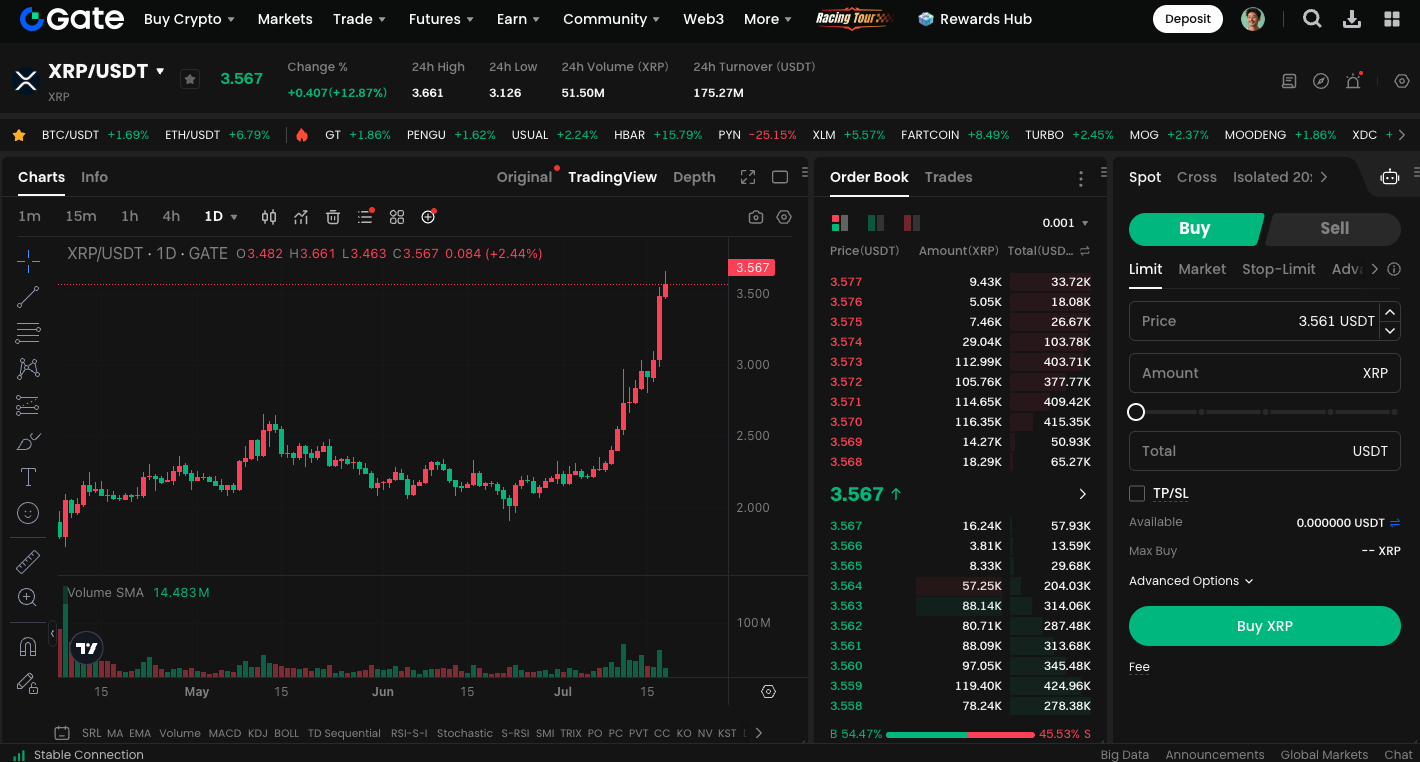
For users, the XRP_USDT trading pair is not only an entry to the XRP market but also a window into Ripple’s ecosystem progress. Real-world deployments of stablecoins, expansion of charitable models, and cross-chain use cases on the XRPL sidechain all have the potential to drive future XRP value. Ripple’s compliance-first strategy enhances its flexibility and long-term credibility in global payments. As regulatory requirements become more stringent in multiple jurisdictions, projects designed with compliance as a core attribute are more likely to attract institutional investment.

Ripple’s Vision

The future of stablecoins extends beyond fast transactions and low fees. Ripple aims to build a global financial infrastructure where even small households can transfer funds as seamlessly as large institutions. This vision includes:

  • Low-barrier user access
  • Immediate settlement and auditability
  • No restrictions by business hours or geography
  • Highly compliant, traceable transaction records

Within this framework, XRP is positioned not merely as a speculative asset but as the foundational resource for financial inclusion.

Start trading XRP spot: https://www.gate.com/trade/XRP_USDT
Summary

As Web3 enters an era of practical application, Ripple’s dual strategy (RLUSD + XRPL EVM) represents more than functional upgrades—it drives a bottom-up transformation in payments. XRP is becoming one of the few assets with both visionary objectives and verified use cases. From philanthropy to supply chains, payroll to exchange deposits and withdrawals, every XRP transaction is a real-world test of the new on-chain payment paradigm.

Author: Allen
Disclaimer
* The information is not intended to be and does not constitute financial advice or any other recommendation of any sort offered or endorsed by Gate.
* This article may not be reproduced, transmitted or copied without referencing Gate. Contravention is an infringement of Copyright Act and may be subject to legal action.

Related Articles

AI-Native Settlement Layers: How United Stables Is Building the Next Financial Rail
Beginner

AI-Native Settlement Layers: How United Stables Is Building the Next Financial Rail

Stablecoins were originally designed as dollar substitutes within exchanges, primarily used for asset pricing and trade settlement. As on-chain financial ecosystems have matured, their role has expanded beyond simple payments to include collateral assets, cross-chain liquidity mediums, and unified settlement units. In particular, as AI systems and automated agents begin to participate directly in economic activity, demand has risen sharply for programmable value units capable of instant settlement. This shift is pushing stablecoins toward the role of foundational financial infrastructure.
2026-03-25 03:16:17
The ve(3,3) Flywheel Explained: How AERO Tokenomics Powers Aerodrome’s DeFi Economy
Beginner

The ve(3,3) Flywheel Explained: How AERO Tokenomics Powers Aerodrome’s DeFi Economy

In the competition for DeFi liquidity, high-inflation mining alone is no longer enough to build lasting advantages. Aerodrome applies the ve(3,3) economic model to redesign token emissions, voting mechanisms, and revenue distribution, creating a liquidity flywheel centered on governance and cash flow. This article examines AERO tokenomics, the veAERO locking mechanism, and protocol revenue models to explain how Aerodrome builds a sustainable DeFi economic system.
2026-03-25 06:41:58
Aerodrome Tokenomics: How ve(3,3) Powers Base's Most Profitable DEX
Beginner

Aerodrome Tokenomics: How ve(3,3) Powers Base's Most Profitable DEX

AERO is the native token of Aerodrome Finance, a core decentralized exchange and liquidity protocol in the Base ecosystem. It is primarily used for liquidity incentives and ecosystem operations. veAERO is a governance NFT that users receive by locking AERO, representing both voting power and the right to share protocol revenue. Through a dual track structure of AERO as a utility token and veAERO as a governance credential, Aerodrome separates liquidity usage value from long term governance power, allowing participants to act as liquidity providers, governance decision makers, and revenue sharers within the same system.
2026-03-25 06:40:31
How is the price of PAXG determined? Pegging mechanism, trading depth, and influencing factors
Beginner

How is the price of PAXG determined? Pegging mechanism, trading depth, and influencing factors

PAXG (Pax Gold) is a tokenized asset backed by physical gold reserves, launched by fintech firm Paxos and issued as an ERC-20 token on the Ethereum blockchain. The core concept is to digitally represent real-world gold assets, allowing investors to hold and trade gold via the blockchain network. Because each PAXG token corresponds to a specific quantity of physical gold, its price is theoretically expected to closely track the global gold market.
2026-03-24 19:11:40
How Does PAXG Work? In-Depth Overview of the Physical Gold Tokenization Mechanism
Beginner

How Does PAXG Work? In-Depth Overview of the Physical Gold Tokenization Mechanism

PAXG (Pax Gold) is a tokenized asset backed by physical gold, issued by the fintech company Paxos and traded on the Ethereum blockchain as an ERC-20 token. The core concept is to tokenize physical gold on-chain, with each PAXG token representing ownership of a certain amount of gold. This structure enables investors to hold and trade gold in the form of a digital asset.
2026-03-24 19:12:51
Hybrid Collateral Stablecoins: Inside United Stables' Stability and Yield Architecture
Beginner

Hybrid Collateral Stablecoins: Inside United Stables' Stability and Yield Architecture

In the early stages of the crypto market, traditional stablecoins mainly relied on single-reserve or single-collateral models. Their primary focus was price stability and payment convenience, which allowed them to become foundational tools for on-chain trading and capital flows. As the market has entered a more mature financial phase, however, this structure has begun to reveal limitations, including high concentration risk and the difficulty of balancing liquidity with yield. These constraints have driven the evolution toward multi-layer collateral and portfolio-based designs, such as the dual-layer hybrid collateral architecture proposed by United Stables, which seeks to redefine the underlying logic of stable assets.
2026-03-25 03:17:39





